
Overview
How Atomgigs works: sources, catalysts and buyers
Atomgigs does not build machines. It helps makers go to market, advises buyers and delivers work done and data.
- Go-to-market: where, how and to whom
- Gigs: jobs for their machines and talent
Paid by Makers: GTM fees; buyers: per gig
- Advice and investor diligence
- Project bidding and execution
Paid by Catalysts: advice, projects
- Hyperscalers
- Colocation providers
- Neoclouds
- AI labs
- Enterprise and edge
- Automakers
- Other manufacturers
- 3PLs (logistics firms)
- Carriers
- Warehouse operators
- Builders and owners
- Program managers
- Energy and power
- Mining, oil and gas
- Transit and telecom
- Public works
- Police, fire and rescue
- EMS
- Security operators
- Corrections and border
- Military installations
- Defense primes
- Healthcare
- Hospitality
- Real estate, facilities
- Food service
- Retail and agriculture
- Waste and recycling
- Data to train robots
- Real-site task data
- Video and sensor data
- Labs pay for the data
- Buyers get a discount
We offer Advice and work done for buyers; data for physical AI labs. Paid by Buyers: advice, capacity; labs: data
Numbers 01 to 12 are primer numbers: each box has its own detailed primer.
Ten facts every partner should know.
The market, the pressures and the opening for physical AI.
- $2.19 trillion a year
- U.S. construction spending, September 2026, annual rate (Census).
Contractors grew 11.8%
Top 400 revenue reached $671 billion in 2025; new contracts rose 22.4%.
Data centers up 86.4%
The fastest-growing market on the Top 400 list, pulled by hyperscaler spending.
- $158.7 billion in design
- Top 500 design firm revenue grew 7.4% in 2025.
- 349,000 workers short
- Net new construction workers needed in 2026; 456,000 in 2027.
Productivity lag
The U.S. economy tripled output per worker since 1948. Construction did not.
Late and over budget
Large projects typically run 20% longer and up to 80% over budget.
- 79% use jobsite robots
- Of surveyed contractors in 2026, up from 29% in 2025.
Design-build above 44%
Share of U.S. spending, heading to 47% by 2028.
Atomgigs connects it
Machines, people and operation, led by a small senior pod on your project.
Your world
The project landscape, what is changing, the project lifecycle, delivery methods and contracts, the partner landscape.
1.1 The project landscape
How big the market is, who builds and designs it, and where the growth is coming from.
Six terms used throughout this primer
8
Design and specialty trades grew with them
11
A $2.19 trillion market in four blocks
9
Data centers, power and water led 2025 growth
12
The largest contractors grew 11.8% in 2025
10
Hyperscaler spending pulls the whole chain
13
Six terms used throughout this primer.
Plain definitions, so every page reads the same way.
Partner
Your firm, in its relationship with Atomgigs: an engineering, design, MEP, construction, program-management or development firm that works on major projects.
Your client
The owner or developer you serve on a project.
Atomgigs client
Whoever hires and pays Atomgigs. It can be your firm, or your client, with you alongside.
Physical AI
Robots, drones, automation, IoT devices and digital twins that do or support work in the physical world.
Site pod
The small senior team Atomgigs puts on a project. Humans in the lead, physical AI in the loop.
Pilot
A scoped, time-boxed trial of physical AI on a live project: four to eight weeks from scope to decision.
Atomgigs sits between the machine maker and your project, so your client deals with one team, led by you.
A $2.19 trillion market in four blocks.
U.S. construction put in place, September 2026, seasonally adjusted annual rate (Census).
SHARE OF TOTAL SPENDING
Total spending is 2.7% below a year earlier, even as data center construction runs at about $97 billion a year.
Nonresidential and public work, about $1.34 trillion a year, is where most partner projects sit.
The largest contractors grew 11.8% in 2025.
ENR Top 400 Contractors: revenue, new contracts and backlog.
REVENUE BY OWNER TYPE
Seven in ten report higher backlog than a year earlier; work is arriving faster than crews to build it.
The work is there. What contractors lack is craft labor and schedule.
Design and specialty trades grew with them.
ENR Top 500 Design Firms and Top 600 Specialty Contractors, 2025 revenue.
SPECIALTY CONTRACTORS: ELECTRICAL, MECHANICAL, UTILITY
| $158.7B | Combined revenue, up 7.4% |
|---|---|
| $136.3B | Domestic, up 8.1% |
| $22.4B | International, up 3.2% |
| 83.2% | Of firms grew revenue; the top ten hold 32.2% |
| $275.1B | Combined revenue, up 14.7% |
|---|---|
| $28.5B | Largest firm by revenue (Quanta Services) |
| $17.0B | Second largest (EMCOR Group) |
| Top 50 | Specialty firms earn under 10% of industry revenue; the field is fragmented |
Specialty trades grew fastest, and they employ the craft labor that robots can support.
Data centers, power and water led 2025 growth.
Change in Top 400 contractor revenue by market, 2024 to 2025.
Oil and gas
-4.8%
Manufacturing
-28.5%
Growth is concentrated in a few markets, and those are the markets where labor is tightest.
Hyperscaler spending pulls the whole chain.
Capital spending by Amazon, Alphabet, Microsoft and Meta.
HOW THE SPENDING REACHES YOUR FIRM
Every dollar of capex becomes design hours, power work and trade labor. Firms that serve these projects are the ones short of people first.
Go deeper: Primer 07 Data Centers covers owners, builders and the full project chain.
1.2 What is changing
Labor, productivity, schedule and owner expectations: the pressures on every firm.
The industry must find 349,000 workers in 2026
15
Contractors are adopting robots fast
19
Data centers absorb the scarcest trades
16
Six questions worth having an answer to
20
Productivity has not kept pace
17
Three pressures, one response
21
Large projects still run late and over budget
18
The industry must find 349,000 workers in 2026.
Net new construction workers needed to balance supply and demand, ABC estimate, January 2026.
- 92% of firms that are hiring
- Report difficulty finding qualified workers, in the 2025 AGC and NCCER workforce survey.
Nonresidential specialty trades
Added 95,000 jobs between August 2024 and early 2026, and still cannot keep up.
The gap is structural: it comes from retirement as much as from growth.
Data centers absorb the scarcest trades.
Electricians and mechanical trades are pulled toward the largest projects first.
- 95,000 jobs added
- By nonresidential specialty trade contractors between August 2024 and early 2026.
- 72% report higher backlog
- Of Top 400 contractors. Work is arriving faster than crews to build it.
A craft ceiling
Top 400 contractors describe more work than skilled people to build it, with data centers taking the electrical and mechanical trades.
Retirement drives the gap
More than half of the 2026 need is replacing retirees, and about 20% of the workforce is over 55.
Hiring alone will not close this gap in time. Machines that take repetitive tasks free skilled crews for skilled work.
Productivity has not kept pace.
U.S. labor productivity since 1948: most sectors multiplied output per worker; construction did not.
OUTPUT PER WORKER, 1948 TO 2023 (1.0 = 1948 LEVEL)
Most U.S. sectors
3.0x
Construction
1.0x
Flat
Construction output per worker, while the rest of the economy more than tripled (Richmond Fed)
Productivity is a methods problem. Machines that repeat a task to the same tolerance every time attack it directly.
Large projects still run late and over budget.
McKinsey's studies of large capital projects across asset classes.
Typical large project
Takes about 20% longer than scheduled and runs up to 80% over budget across asset classes.
Where it comes from
Late decisions, rework, trade stacking and weak progress data: the points where measured, repeatable work helps most.
On large work, late and over budget is the norm. A credible plan to hold schedule wins an owner's trust.
Contractors are adopting robots fast.
Share of surveyed general and specialty contractors using jobsite robotics.
CONTRACTORS USING JOBSITE ROBOTICS
2025
29%
2026
79%
#1
Benefit named by contractors: accuracy, ahead of labor savings and safety
Your competitors and your clients are already trying robots. The question is who runs them well.
Six questions worth having an answer to.
Questions an owner can reasonably put to a project team in 2026.
What is your labor plan for the peak months?
Named crews, hours and the fallback if trades are short.
How will you hold the schedule?
The tasks that set the critical path and what takes risk off them.
How do you keep people out of the worst work?
Overhead drilling, heights, confined spaces and repetitive strain.
Can you show progress and quality weekly?
Captured data, compared with the model, not a walk-through.
What is your approach to robots, drones and automation?
Where you use them, who runs them and what they delivered.
How do you hand over what was built?
A digital record the owner can use to operate the asset.
Atomgigs helps you answer all six with a plan, a pilot and measured results.
Three pressures, one response.
How the challenges map to what machines and a led site pod do.
Too few skilled workers, and the scarcest trades go to the biggest projects.
Labor gap
Rework of 4 to 6% of contract value, and decades without gains.
Flat productivity
Large projects run late, and progress is hard to see in time.
Schedule risk
Machines take repetitive, hazardous and precision tasks. People supervise and do the skilled work.
Repeatable tasks run to the same tolerance, with data captured as they are done.
Work can extend beyond a normal shift, and progress is measured daily against the model.
Humans in the lead, physical AI in the loop: a small senior pod leads the machines, and each robot has a named human manager.
1.3 The project lifecycle
Six phases, and the points where physical AI changes the outcome.
Six phases, six chances
23
Construction: where the hours are
27
Where each technology lands
24
Handover and operations
29
Design and preconstruction
26
One data thread
30
Six phases, six chances to use physical AI.
From the first idea to years of operation.
- 1Plan
WHAT HAPPENS Feasibility, site selection and budget
- 2Design
WHAT HAPPENS Schematic design, development and construction documents
- 3Preconstruction
WHAT HAPPENS Estimating, procurement, schedule and VDC coordination
- 4Construction
WHAT HAPPENS Building the work on site
- 5Commissioning
WHAT HAPPENS Testing, punch list and handover
- 6Operations
WHAT HAPPENS Running the asset for years
Drone and scan survey of existing conditions
A digital twin baseline and robot-ready design data
Schedule built on robot capacity; machine scopes priced
Layout, drilling, tying, finishing, scanning, moving, inspecting
Automated as-built scans and inspection
Facility robots, patrols and sensor monitoring
The earlier physical AI enters the plan, the more it can change. Decisions in design shape what machines can do on site.
Where each technology lands in the lifecycle.
Five families of physical AI across the six phases.
| Plan and design | Preconstruction | Construction | Commissioning | Operations | |
|---|---|---|---|---|---|
| Robots | Mock-ups | Prefab cells | Layout, drilling, tying, printing, finishing | Inspection patrols | Facility service and security |
| Drones | Site survey and mapping | Existing-condition capture | Progress capture, volumes, roofs | As-built verification | Roof, facade and asset inspection |
| IoT and sensors | Site monitoring | Pilot sensor plans | Environment, equipment and people-safety sensing | Commissioning data points | Building performance |
| Digital twins | Baseline model | Clash and schedule simulation | Plan versus actual | As-built twin | Operating twin |
| Automation | Design automation | Prefab and off-site factories | Machine-guided equipment | Test automation | Building controls |
Chapter 2 goes through each technology, with the level of proof and named deployments.
Housing modules built on a factory floor.
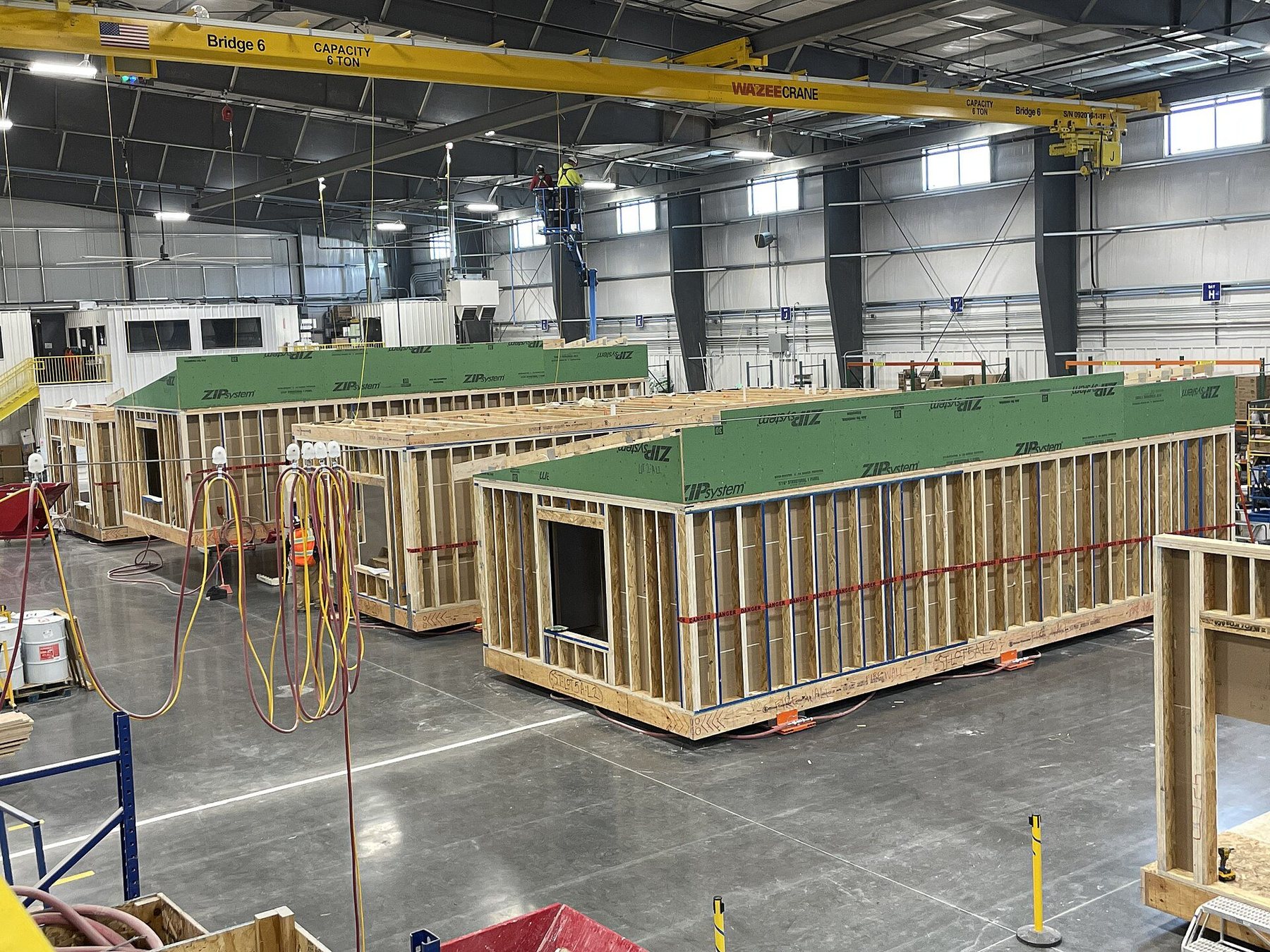
- Wood-frame housing modules in a modular factory in Buena Vista, Colorado.
- Walls, floors and roofs are framed and sheathed indoors, then trucked to site and set by crane.
- Repeat work under a roof is where robot arms and automated framing lines arrive first.
Photo: USDA, Wikimedia Commons (public domain)
Design and preconstruction set the outcome.
What a project team does early decides what machines can do later.
Capture existing conditions
Drone and scanner surveys give a measured model before design hardens.
Write a model machines can read
Coordinates, tolerances and tags that layout, drilling and tying robots take straight from BIM.
Review constructability for robots
Access, reach, floor flatness, power and the open area a robot needs to work.
Build the schedule on robot capacity
Plan crews and machines together so the critical path reflects both.
Price machine scopes early
Atomgigs estimates the scope so it enters the bid with a number.
Order long-lead items
Robots, batteries and sensors carry lead times that belong in the procurement plan.
Bring physical AI into the pursuit and the preconstruction plan, not the change-order log.
Construction is where the hours are.
Tasks where machines already work beside crews.
| Task | What the machine does | Why it helps |
|---|---|---|
| Layout | Prints full-scale layout on the slab from the model | Fast, accurate marking |
| Drilling | Drills ceiling anchor holes to the model | Overhead work taken off crews |
| Rebar | Ties intersections on decks and slabs | Repetitive, strenuous work |
| Finishing | Sprays and sands drywall | Consistent finish |
| Scanning | Walks or flies the site capturing images and point clouds | Daily progress data |
| Moving materials | Autonomous carts, haulers and forklifts | Fewer manual carries |
| Inspection | Patrols with thermal, gas or leak sensing | Less exposure to hazards |
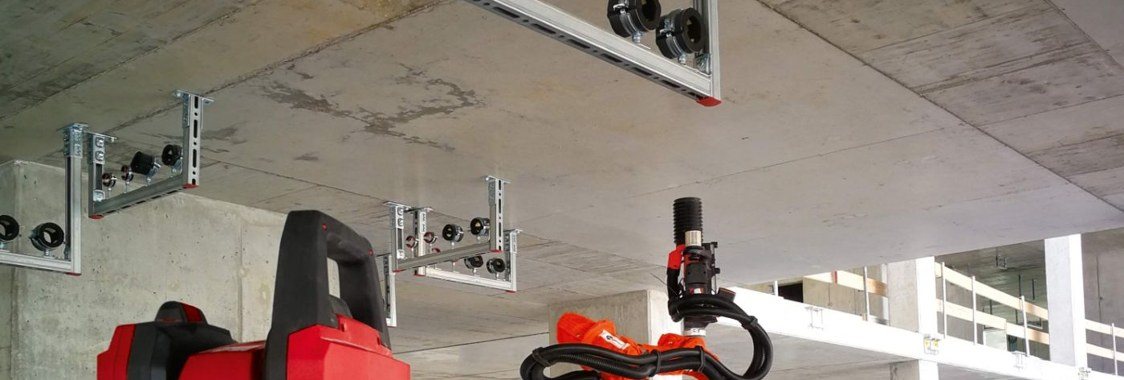
- Hilti Jaibot drilling robot
- Image: Hilti
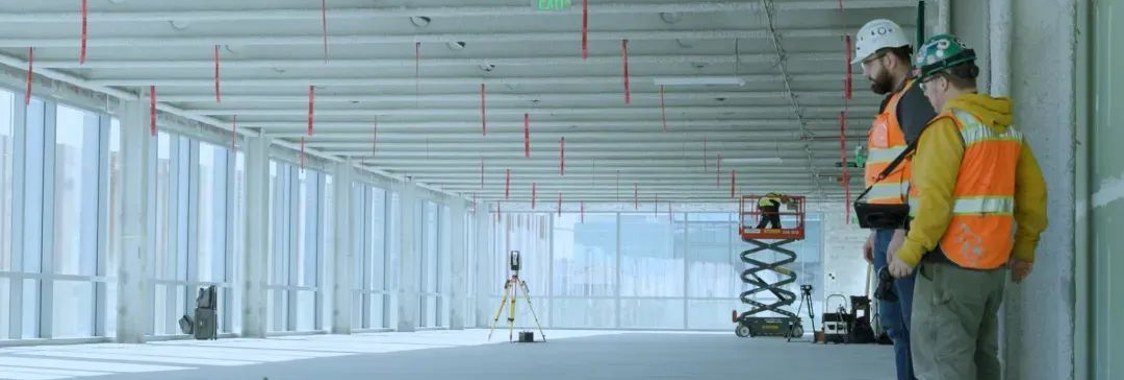
- FieldPrinter marking layout on an open floor
- Image: Dusty Robotics
Chapter 2 covers each of these in depth, with makers, cost and the level of proof.
Overhead MEP work is repetitive work at height.
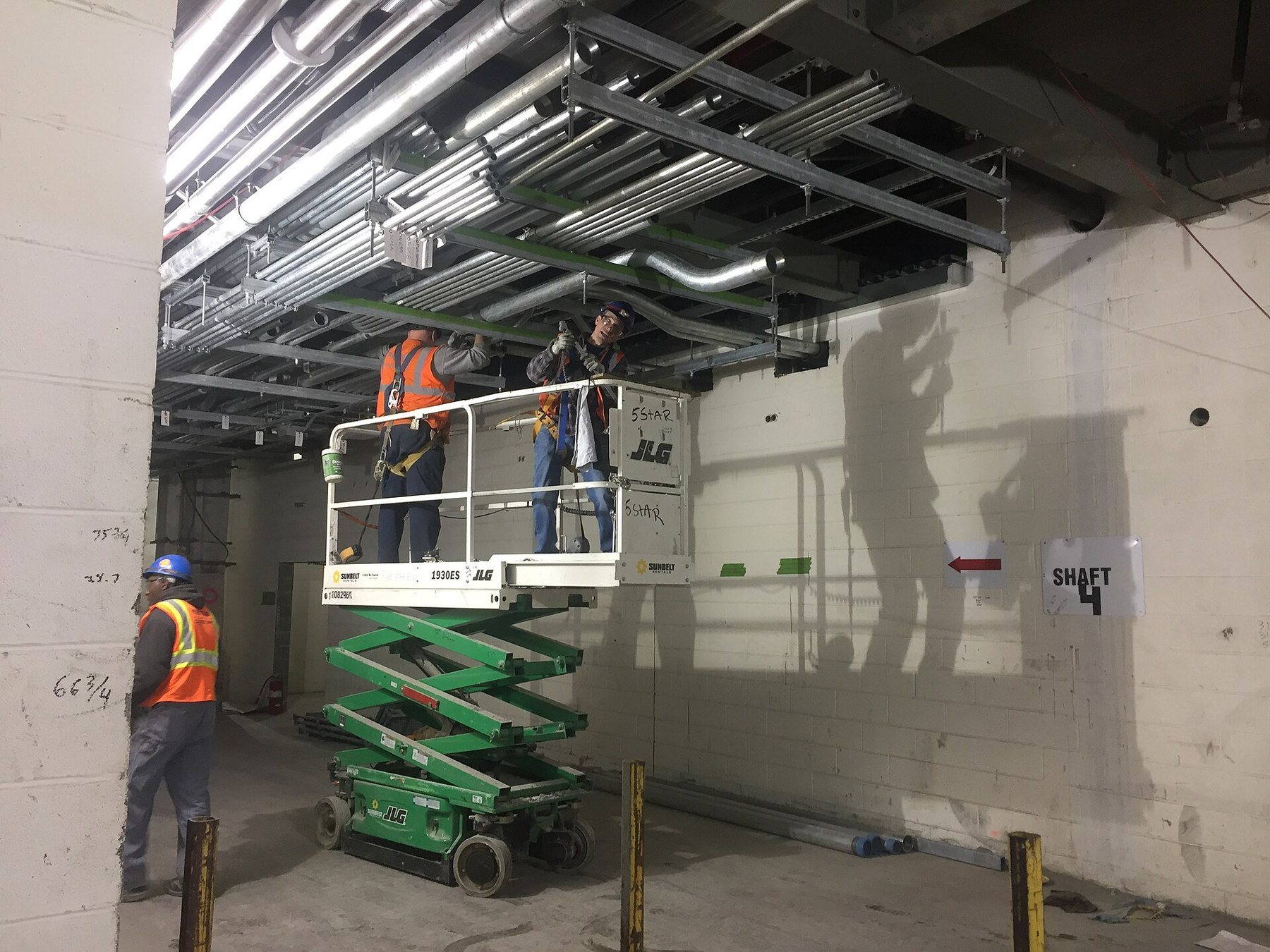
- Crews install ductwork and hangers from a scissor lift in a new rail concourse in New York.
- Every hanger first needs an anchor hole drilled overhead: the task ceiling-drilling robots take on.
- Layout robots mark sleeve and hanger positions on the slab below, straight from the model.
Photo: MTA Capital Construction, Wikimedia Commons, CC BY 2.0
Handover is where data becomes value.
Commissioning, handover and operations.
Verify what was built
Scans compared with the model show deviations while crews are still on site.
Close faster
Punch items are located, logged and re-checked with captured evidence.
Hand over a living record
The owner receives a digital twin, not a stack of drawings.
Stay to operate
Atomgigs can stay after handover: patrols, inspection and monitoring run by the same pod.
Staying to operate gives your client one team from build to operations, and gives you a longer relationship.
One data thread runs through every phase.
BIM and VDC data feed the machines; the machines feed back what was built.
Layout and drilling robots
Take points and holes from the model
Drones and ground scanners
Capture progress as point clouds
BIM and VDC model
Coordinates, tolerances, schedule
Digital twin
Plan versus actual, updated daily
Owner handover
As-built twin for operations
Your VDC and BIM team already hold the data machines need. Atomgigs connects it to the field.
A laser scan turns a built room into model data.
- A mechanical room captured as a point cloud (grey), with the pipes modeled from it (teal).
- Scans like this show what was actually built, ready to compare with the design model.
- The same data guides layout and drilling robots and becomes the owner's as-built record.
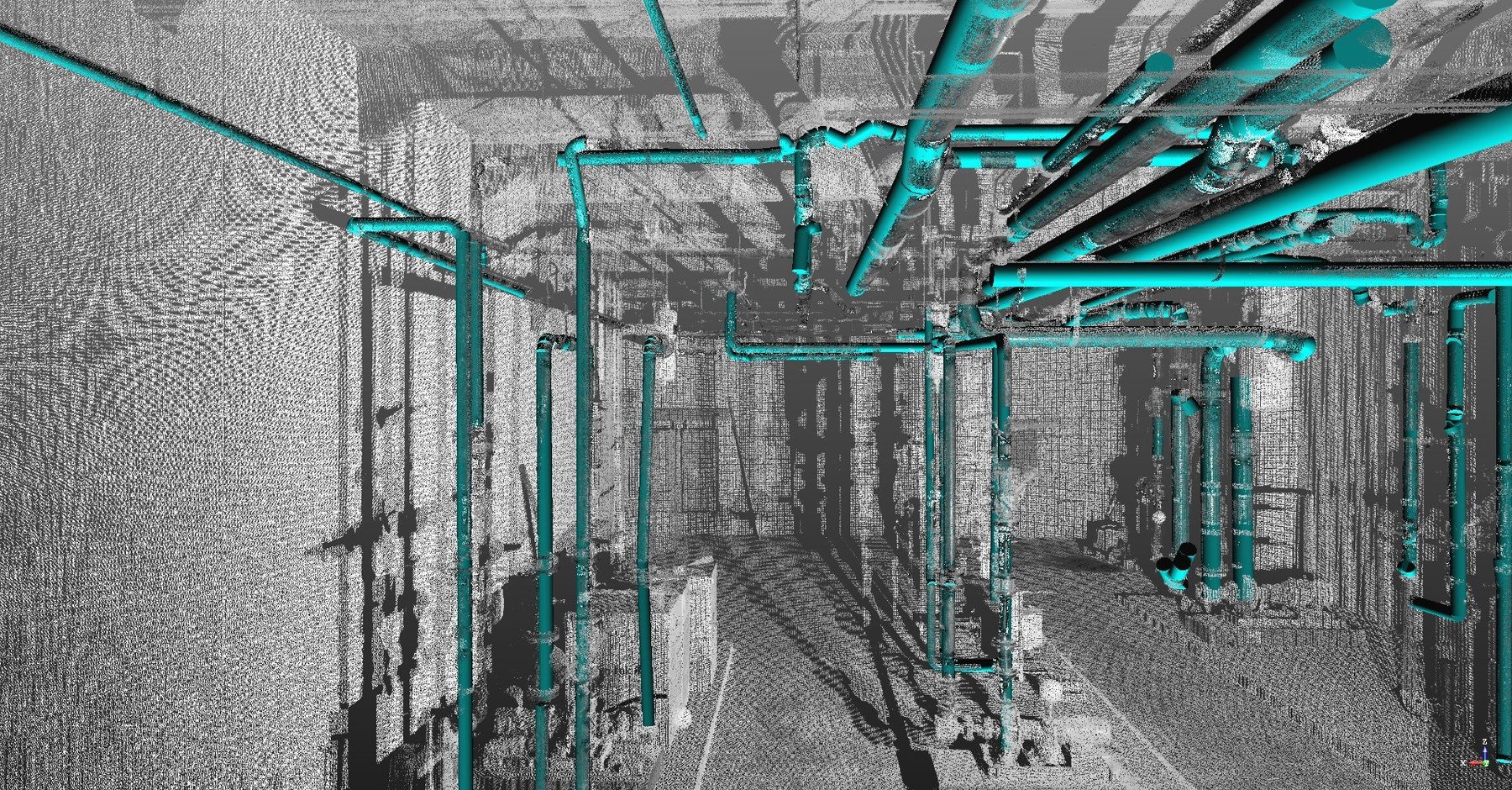
Photo: Oregon State University, Wikimedia Commons, CC BY-SA 2.0
1.4 Delivery methods and contracts
The delivery methods and contract forms you work under, told from your side.
Five delivery methods
33
Four ways price is set
36
Design-build share
34
Who is who on a project
37
Contract forms you know
35
Where a machine scope sits
38
Five delivery methods, and where a machine scope fits.
How the owner contracts, and when to raise physical AI.
| Method | Who holds the contract | How it runs | Where physical AI fits |
|---|---|---|---|
| Design-bid-build | Owner holds separate design and construction contracts | Design finishes, then bids | Specify it in the documents, or add it by change order |
| Design-build | One design-builder holds both | Design and construction overlap | Plan it with the design-builder from concept |
| CM at risk (CMAR) | Owner hires the CM early, who guarantees a price | CM advises in design, then builds | Raise it in preconstruction; price it as a trade package |
| Integrated project delivery | Owner, designer and builder share one agreement | Shared risk and reward | Joint decision with shared savings |
| EPC and EPCM | One firm engineers, procures and builds (EPC) or manages (EPCM) | Large industrial and energy work | Include it in the execution plan and procurement |
The earlier the contractor joins the design, the earlier a machine scope can be planned and priced.
Design-build is becoming the default.
Share of U.S. construction spending delivered by design-build.
Largest segments
Manufacturing, highways and streets, and education are expected to hold the largest design-build share through 2028.
Why it matters to you
One team decides early what to build with and how. That team is where a machine scope is won or lost.
Reach the design-builder before the design is final, when physical AI changes cost and schedule most.
Contract forms you know, and where you meet them.
The standard families that set roles, risk and payment.
| Family | Published by | Where you meet it |
|---|---|---|
| AIA Contract Documents | American Institute of Architects | Widely used on U.S. buildings; A201 General Conditions, 2017 edition |
| ConsensusDocs | Coalition of owner, contractor, design and surety associations | Collaborative delivery on buildings and infrastructure |
| EJCDC | Engineers Joint Contract Documents Committee | Engineer-led public works, water and civil projects |
| DBIA documents | Design-Build Institute of America | Written for design-build projects |
| FIDIC | International Federation of Consulting Engineers | International: Red Book (construction), Yellow Book (plant and design-build), Silver Book (EPC and turnkey) |
Atomgigs works inside the form you already use. A machine scope is a specialty scope, not a new contract type.
Four ways price is set, and how Atomgigs fits each.
Atomgigs prices from its own estimate of the scope; structure is agreed case by case.
| Structure | How price is set | Who carries cost risk | How Atomgigs fits |
|---|---|---|---|
| Lump sum | One agreed price for a defined scope | Contractor | Fits a defined scope with measurable output |
| Cost plus with a guaranteed maximum price | Actual cost plus fee, capped at the maximum | Shared below the cap, contractor above it | Machine cost sits inside the maximum; savings shared as agreed |
| Unit price | A price per unit of work done | Owner on quantity, contractor on rate | A natural fit: price per unit laid out, drilled or tied |
| Time and materials | Hourly or daily rates plus materials | Owner | Machine capacity by the day or week, with outcomes tracked |
Atomgigs offers pay for capacity and outcomes: no capital outlay for machines and no long-term headcount for you.
Who is who on a project, and where Atomgigs plugs in.
The usual cast, and the three points where Atomgigs joins.
Owner or developer
Architect and engineers
Program or construction manager
General contractor or design-builder
Suppliers and equipment makers
MEP and specialty subcontractors
Atomgigs: machines, people, operation
Dashed lines show where Atomgigs joins: as an engineering input, as a trade partner under the contractor, and alongside the supply chain.
Four places a machine scope can sit in your contract.
Each keeps you in front of your client.
- 1 Specialty subcontract under you
- Atomgigs holds a subcontract for the scope, staffs it and operates it. You hold the owner contract.
- 2 Part of your self-performed scope
- You perform the scope with Atomgigs machines and people embedded in your crews.
- 3 Owner-furnished service you coordinate
- The owner contracts Atomgigs directly; you coordinate access, safety and schedule.
- 4 Advisory only
- Atomgigs advises on where and how, and you contract and run the work yourself.
Chapter 4 sets out each partnership model: how it works, what you keep, what Atomgigs does.
1.5 The partner landscape
The large engineering, design, MEP and construction firms, and what each focuses on.
The market is concentrated
40
Movers in the rankings
44
The ten largest contractors
41
Focus areas
45
The ten largest design firms
42
What each firm type cares about
46
Leading specialty and MEP firms
43
The market is concentrated at the top.
Share of revenue held by the largest firms.
Larger firms are gaining share
After a decade of shrinking, the share held by the biggest contractors rose in 2025.
Specialty trades stay fragmented
Thousands of specialty firms do the work, so one project can involve many trade partners.
A few hundred firms shape most large projects, and thousands of specialty firms build them. Atomgigs works with both.
The ten largest contractors.
Ranked by 2025 construction revenue.
| Rank | Firm | 2025 revenue | Focus areas |
|---|---|---|---|
| 1 | Turner Construction | $28.3B | Commercial, healthcare, sports, data centers |
| 2 | Bechtel | $19.5B | Global infrastructure and energy megaprojects |
| 3 | STO Building Group | $15.6B | Commercial, data centers, interiors |
| 4 | Kiewit | $15.3B | Heavy civil, mining, power |
| 5 | Whiting-Turner | $14.7B | Commercial, institutional, retail |
| 6 | MasTec | $14.3B | Utility, communications and clean energy infrastructure |
| 7 | DPR Construction | $14.0B | Technology, life sciences, healthcare, advanced manufacturing |
| 8 | HITT Contracting | $13.0B | Data centers, federal and commercial |
| 9 | Fluor | $10.9B | Global EPC: energy, chemicals, infrastructure |
| 10 | Mortenson | $10.8B | Renewable energy, data centers, sports, healthcare |
The ten largest design firms.
Ranked by 2025 design revenue.
| Rank | Firm | Focus areas |
|---|---|---|
| 1 | Jacobs | Infrastructure, advanced facilities, data centers, program management |
| 2 | AECOM | Transportation, water, buildings, environment, program management |
| 3 | Tetra Tech | Water, environment, government and utility services |
| 4 | WSP | Transportation, buildings, power, environment |
| 5 | Fluor | Engineering and construction for energy, chemicals and infrastructure |
| 6 | HDR | Healthcare, transportation, water, energy |
| 7 | Burns & McDonnell | Power, data centers, industrial; engineering, architecture, construction |
| 8 | Kimley-Horn | Land development, transportation, power, buildings |
| 9 | Stantec | Buildings, water, infrastructure, energy |
| 10 | HNTB | Transportation and infrastructure |
Leading specialty and MEP firms.
Specialty contractors by 2025 revenue; MEP design firms by 2026 MEP Giants rank.
| Quanta Services | $28.5B | Electric transmission and utility |
|---|---|---|
| EMCOR Group | $17.0B | Mechanical and electrical |
| APi Group | $7.9B | Fire protection and safety |
| Comfort Systems USA | $7.9B | Mechanical, HVAC |
| Primoris | $7.6B | Utilities, energy, infrastructure |
| Dycom | $5.6B | Telecom infrastructure |
| 1 | Jacobs No. 1 in MEP design since 2013; $2.39B MEP design revenue |
|---|---|
| 2 | Burns & McDonnell Also No. 1 in power design for the 11th year |
| 3 | Harris Mechanical, electrical and plumbing specialist |
| 4 | WSP Buildings, transportation, power, environment |
| 5 | AECOM Global design and program management |
The 2026 MEP Giants together earned $19.18B in MEP design revenue.
Movers in the rankings, and what they signal.
Data centers and power reshaped the lists in 2025.
Data center builders climbed
Mortenson moved from No. 22 to No. 10, STO Building Group from No. 6 to No. 3 and HITT Contracting from No. 10 to No. 8.
Design is led by Jacobs and AECOM
The two largest design firms, followed by Tetra Tech, WSP and Fluor. The top ten hold 32.2% of design revenue.
Turner holds the top
Turner Construction leads at $28.3 billion, nearly $9 billion ahead of Bechtel.
Power is a growth market
Power contractor revenue grew 14.2%, and Burns & McDonnell is No. 1 in power design for the 11th consecutive year.
Combinations create scale
FlatironDragados, formed in 2024, ranks in the top 25 and first in transportation and domestic heavy contracting.
Specialty firms scale up
Quanta, EMCOR, APi, Comfort Systems and Primoris each earn more than $7 billion; Dycom adds $5.6 billion in telecom.
The fastest-growing firms are building data centers and power: the projects with the tightest labor.
Focus areas: who is strong where.
Examples of firms with a strong position in each sector. Not a complete list.
| Sector | Contractors | Design firms | Specialty trades |
|---|---|---|---|
| Data centers | Turner, STO Building Group, HITT, DPR, Mortenson | Jacobs, Burns & McDonnell | Comfort Systems USA, EMCOR |
| Power and energy | Bechtel, Kiewit, Fluor, Mortenson | Burns & McDonnell, Sargent & Lundy | Quanta Services, Primoris |
| Transportation | FlatironDragados, Kiewit | HNTB, WSP, AECOM | Construction Partners |
| Buildings and healthcare | Turner, Whiting-Turner, DPR, Gilbane | HDR, Stantec, SmithGroup | EMCOR, Comfort Systems USA |
| Industrial and manufacturing | Fluor, Kiewit, DPR | Arcadis, Burns & McDonnell | EMCOR, Rosendin |
Match the conversation to the firm's focus: the same machine scope reads differently to a data center builder and a transit engineer.
What each firm type cares about.
The worry that opens the conversation, and where Atomgigs helps.
| Firm type | The worry | Where Atomgigs helps |
|---|---|---|
| Design and architecture | Making designs buildable and measurable | Robot-ready design data; reality capture of existing conditions |
| Engineering | Technical risk, standards, power and systems | Engineering input on machine scope; safety case; performance data |
| MEP and specialty | Labor, schedule and rework | Machines and people for layout, drilling, tying and inspection |
| General contractor or builder | Schedule, margin and safety | A site pod, a pilot and measured results |
| Construction and program manager | Control and reporting | Daily progress data and reporting against the model |
| EPC, EPCM and data center builder | Scale, speed and labor at peak | Multi-site rollout and operations |
Chapter 5 takes each firm type in turn, with a pilot package and an example conversation with the owner.
Physical AI on projects
The technologies, what the evidence shows, the economics, safety, standards and liability, readiness.
2.1 The technologies
Five families of physical AI, matched to the tasks on your projects.
Five families, one toolbox
49
Proven machines from other industries
52
Ten jobs on site today
50
Four ways people and robots share work
53
Form factor decides
51
Autonomy added to machines you own
54
Five families of physical AI, one toolbox.
Each family covers a different part of the project, and they work best together.
Robots
Mobile platforms, arms, legged robots and humanoids that move, lift, drill, tie, print and finish.
Drones
Aerial capture of progress, volumes, roofs and facades, compared with the model.
Sensors and IoT
Devices that sense power, temperature, flow, leaks, vibration and people-safety conditions.
Digital twins
A living model of the site that links plans, as-built scans and operating data.
Automation and smart equipment
Autonomy added to excavators, haulers and pile drivers, and controls inside the building.
The people who run them
A small senior pod with named human managers. Machines without operators do not finish work.
Atomgigs matches the tool to the task, and is not tied to any one maker.
Ten jobs cover what robots do on site today.
Grouped by the work performed; maturity in 2026.
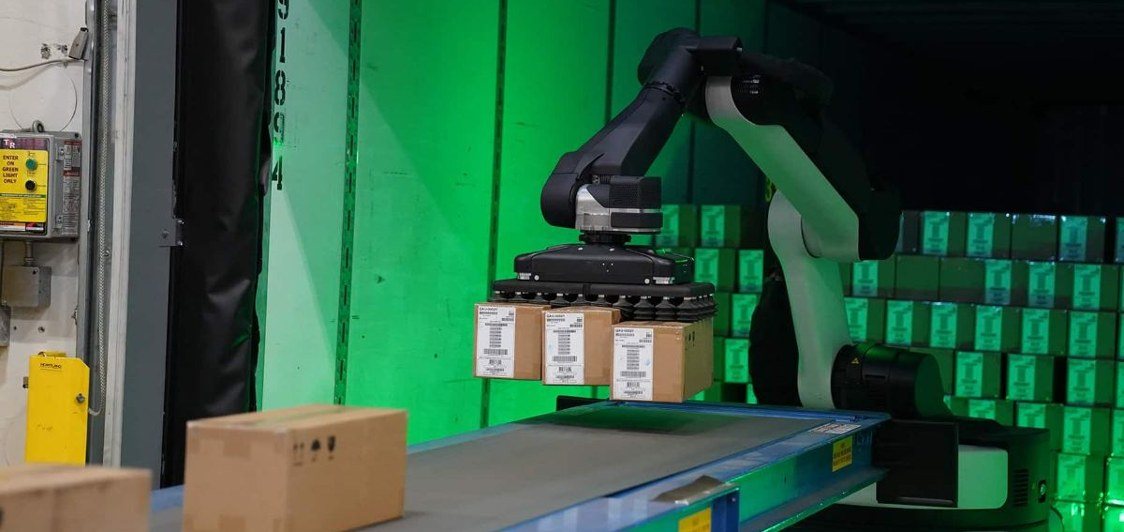
| Function | Typical robots | Typical sites | Status today |
|---|---|---|---|
| Material handling | AMRs, forklift AGVs, tuggers, truck unloaders | Warehouses, factories, laydown yards | Scaled |
| Welding and assembly | Industrial arms and cobots | Factories, prefab shops | Scaled |
| Picking and sortation | Arm plus vision systems | Fulfillment centers | Commercial |
| Cleaning and security | Floor scrubbers, patrol robots | Warehouses, campuses, data centers | Commercial |
| Inspection and monitoring | Quadrupeds, drones, wall crawlers | Plants, vessels, data center halls | Commercial |
| Layout and marking | Layout-printing robots | Construction floors | Commercial |
| Drilling and anchoring | Ceiling-drilling robots | Construction MEP work | Commercial |
| Earthmoving and piling | Autonomous excavators, haulers, pile drivers | Civil, solar and large sites | Early commercial |
| Finishing and rebar | Drywall robots, rebar tyers | Interiors, bridge decks | Early; rebar commercial |
| General manipulation | Humanoids and mobile manipulators | Pilots across many sites | Pilot |
- Stretch moving cartons at a dock door
- Image: Boston Dynamics

- Gecko crawler on a steel vessel
- Image: Gecko Robotics
Form factor decides where a robot can go.
Pick the body by the site, not the other way round.

Wheeled and tracked
Carry loads and layout tools across flat slabs and yards.
Legged
Walk stairs and rough ground on inspection rounds. Proven at inspection, not manipulation.
Aerial
Drones cover roofs, facades and large areas fast, with no ground access needed.
Arms on a base
Drill, tie, spray and sand from a fixed or mobile base, guided by the model.
- Spot with a manipulator arm
- Photo: Lukas Schulze / Web Summit via Sportsfile, Wikimedia Commons, CC BY 4.0
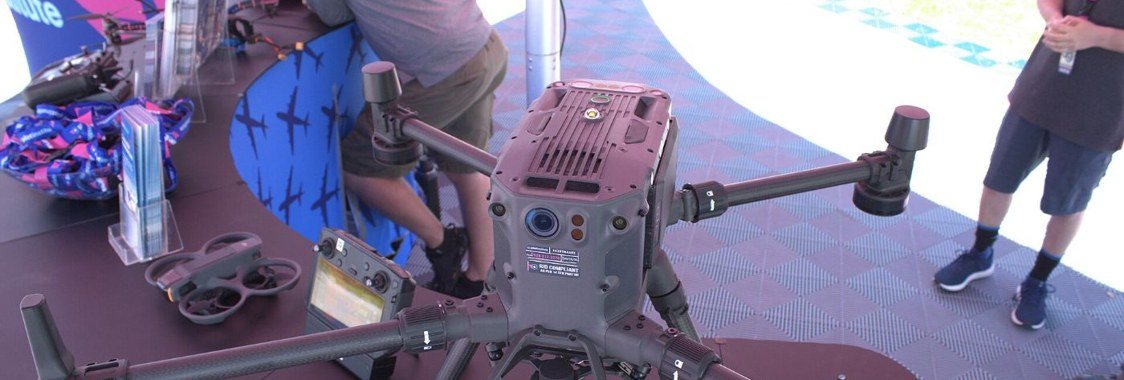
Heavy machines
Autonomous excavators, haulers and pile drivers for civil and solar sites.
Humanoids
Walk and handle in spaces built for people. Mostly pilots so far.
- DJI Matrice 300 RTK drone
- Photo: ZLEA, Wikimedia Commons, CC BY-SA 4.0
A flat, mapped, repetitive site suits wheels. Stairs and clutter call for legs or people.
Proven machines from other industries are already scaled.
Demolition, warehouse and welding robots show what mature automation looks like.
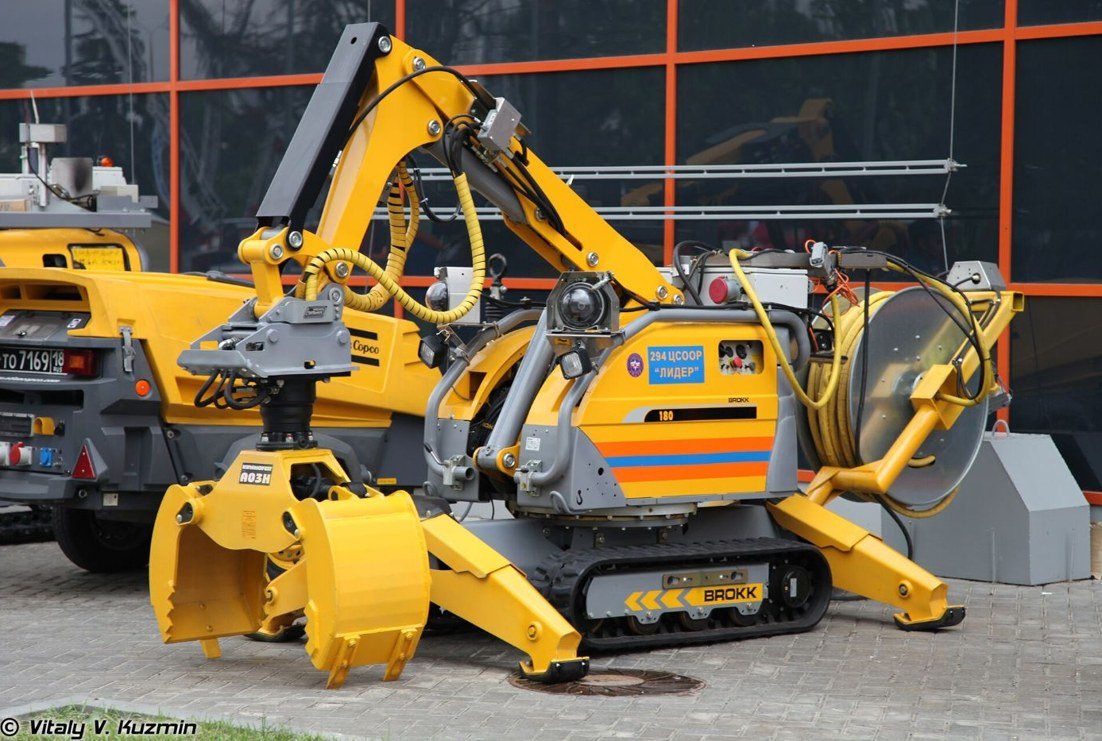
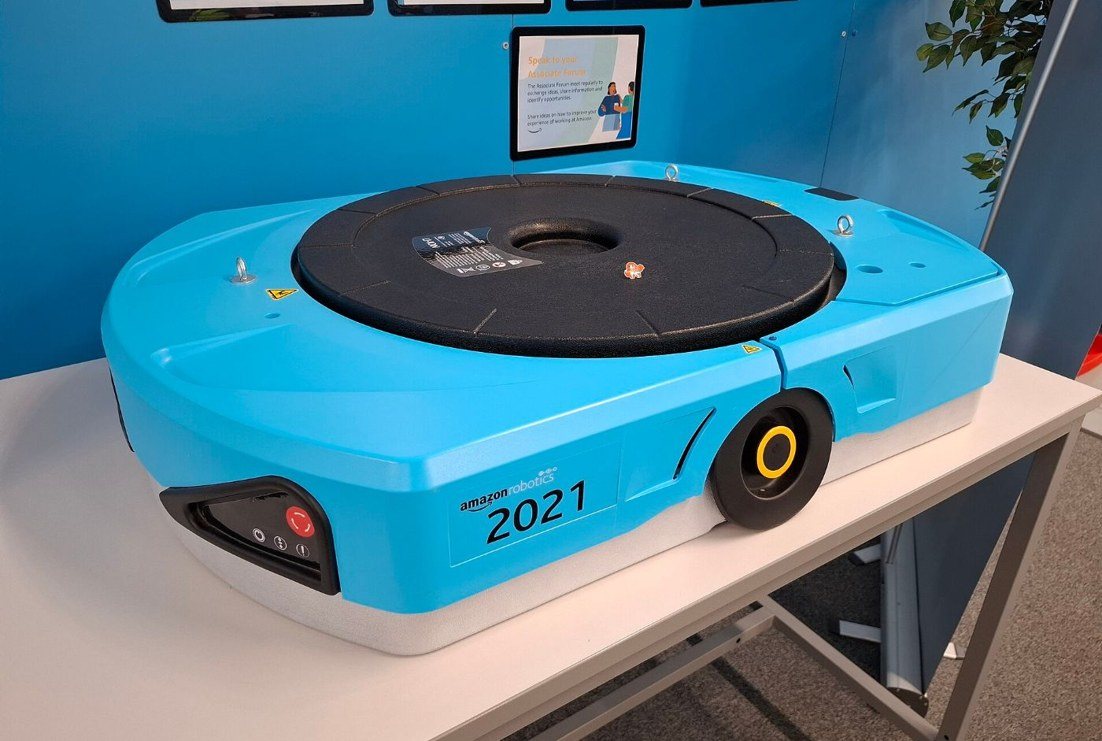
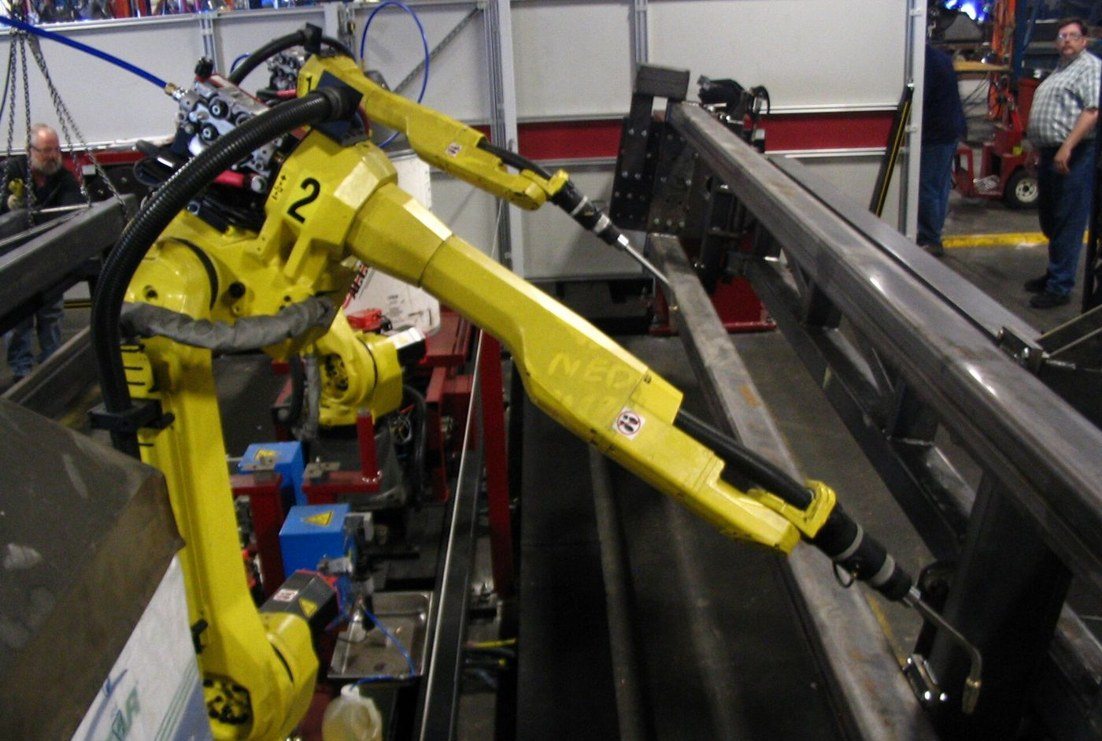
Construction borrows from these proven machines, and adds layout, drilling and finishing.
People lead, robots handle defined tasks.
Four modes describe how people and robots share a site.
| Mode | How it works | Example |
|---|---|---|
| Cooperation | Same area, sequential tasks. The robot does the step before or after the person. | Robot moves materials to a human-run station |
| Shared task | Hands-on with the robot, which responds to human motion and force. | People pick or fit; robots carry |
| Operator-directed | A person directs from a tablet or remote and does touch-up. The robot does the bulk repetitive work. | Finishing and drilling |
| Supervised autonomy | A person sets the job, monitors and resolves exceptions. The robot runs the mission on its own. | Layout from a design model |
Most site robots today are operator-directed or supervised, not shared-task.
Autonomy can be added to machines already on site.
Retrofit kits turn existing excavators and haulers into supervised machines.
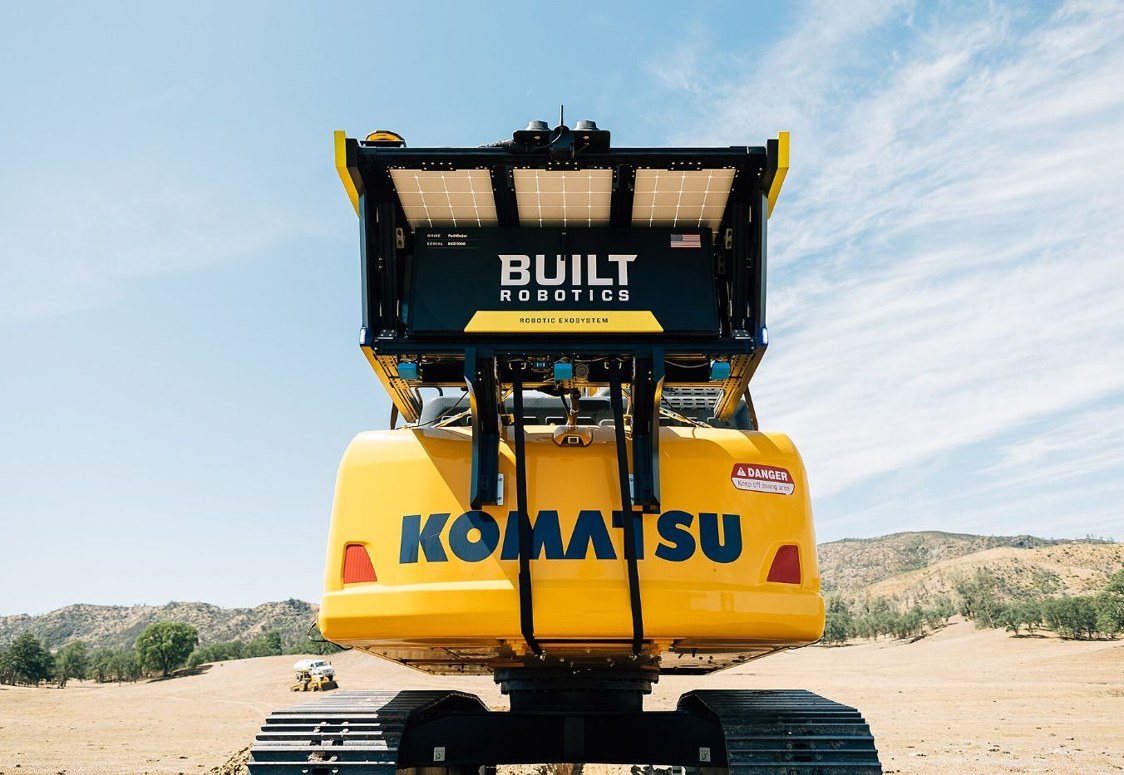
Retrofit kits
Built Robotics rents its Exosystem for excavators. Bedrock sells a kit plus a subscription, backed by nearly $1 billion of funding, including $600 million raised in October 2026.
Mixed fleets
Teleo retrofits brand-mixed fleets for remote supervision. It needs a dealer, a network and a command seat.
Purpose-built machines
Built's RPD 35 piles solar sites. Supervisors can oversee several machines at once.
- Exosystem kit on an excavator
- Photo: Carolinah13 / Built Robotics, Wikimedia Commons, CC BY-SA 4.0
Why it matters
Contractors keep the fleet they own, and raise output without buying a new machine for each task.
For earthwork and piling, the quickest route is often a kit on a machine you already run.
2.2 What the evidence shows
Named deployments, and how mature each task is today.
Task by task
Layout, capture and piling
56
57
Inspection patrols
Humanoids
61
62
Drilling data center slabs
59
Where proof is thin
63
Rebar and finishing
60
Proof differs by task, not by robot.
Task, robots and maturity on construction sites outside data centers.
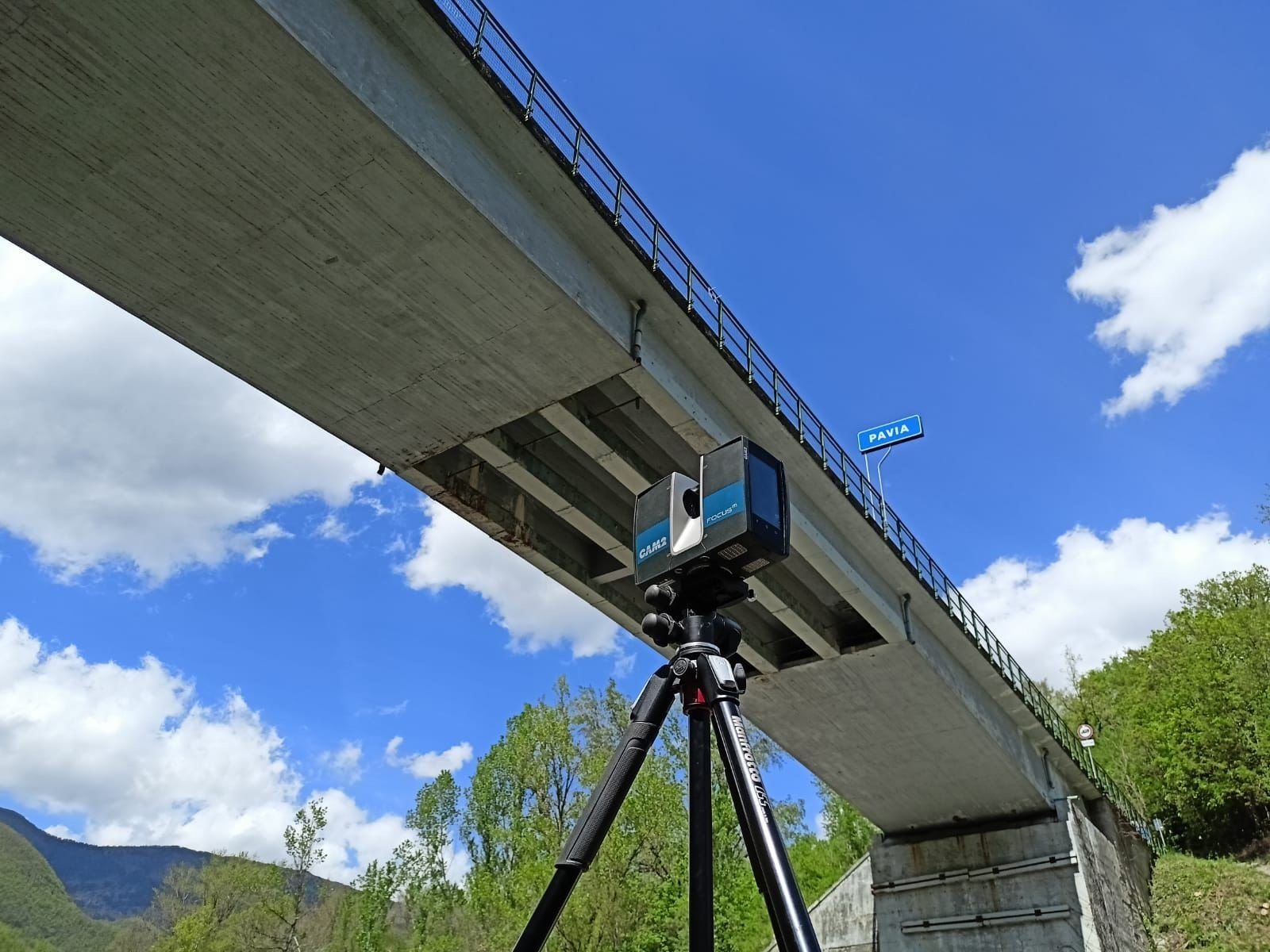
| Task | Robots | Maturity | Detail |
|---|---|---|---|
| Layout | Dusty; Civ Robotics (outdoor) | Commercial | Dusty: 10,000-15,000 sq ft a day; Civ: 8 mm accuracy |
| Progress capture | Spot, drones, Buildots | Commercial | Turner: over 95% less inspection time |
| Overhead drilling | Hilti Jaibot | Commercial | In the market since late 2020 |
| Rebar tying | TyBOT (ACR) | Commercial | Up to 1,100 ties an hour; 4 million+ ties, 65+ deployments |
| Drywall finishing | Canvas | Early commercial | Two days against five to seven by hand |
| Plaster and spray | Okibo EG7 | Early commercial | About 1,000 sq ft an hour; 1 million sq ft in Europe |
| Bricklaying | Monumental; Fastbrick | Early; pilot | Monumental: 100+ homes, 40+ projects |
| Solar piling | Built; Terabase | Commercial; late pilot | Built: 40 deployments, 50,000 hours |
| Demolition | Brokk | Scaled | Remote-controlled since 1976 |
- Laser scanner capturing as-built geometry
- Photo: FedericaGaspari, Wikimedia Commons, CC BY-SA 4.0
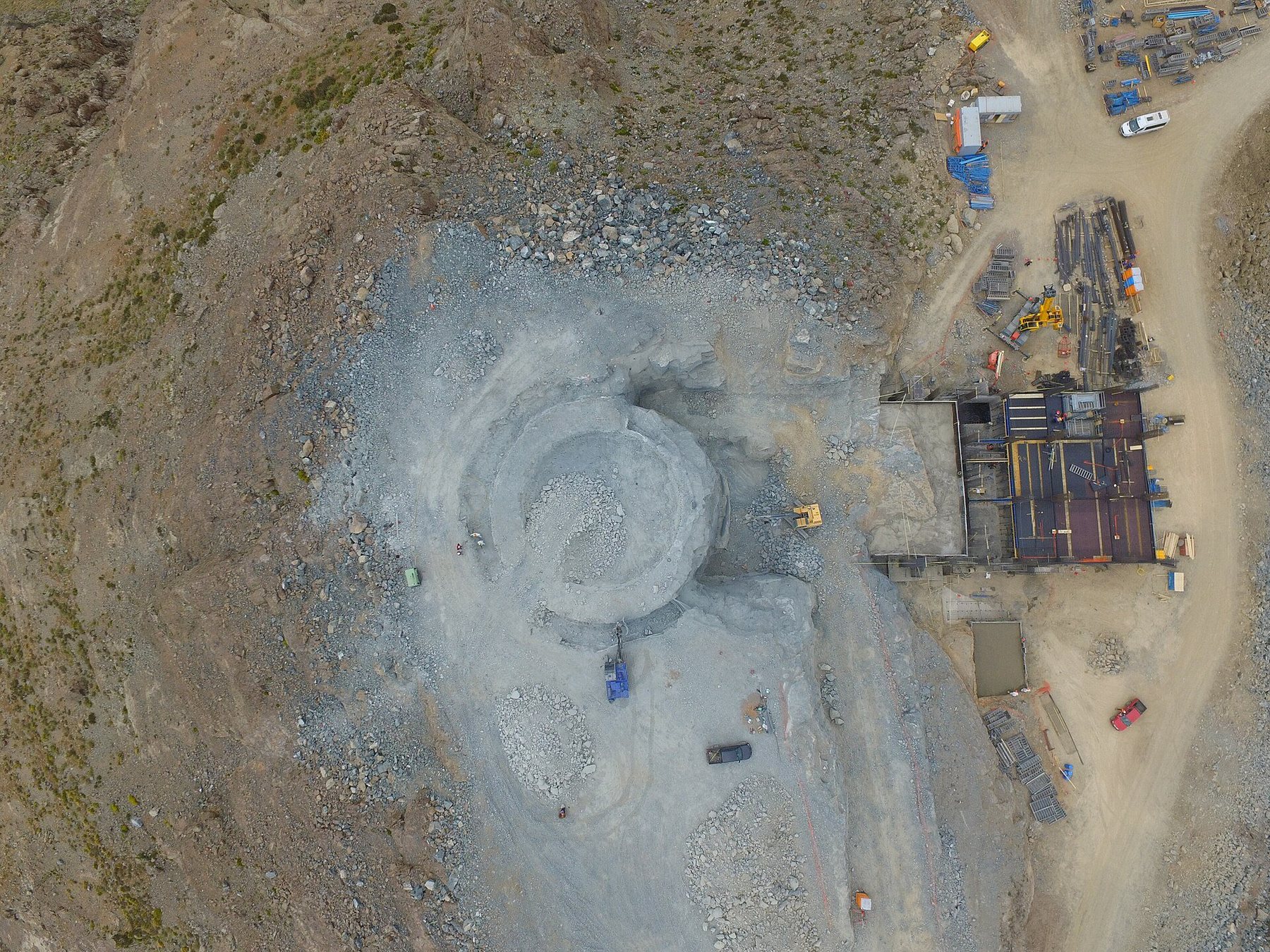
- Drone view of a site, captured for progress mapping
- Photo: Rubin Observatory/NSF/AURA, CC BY 4.0
Layout, capture and piling are in field use.
Named construction-phase deployments with data center links.
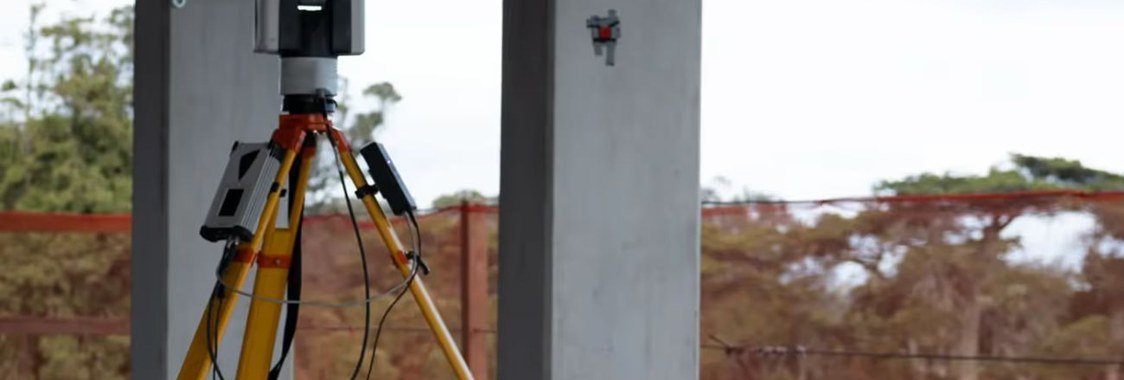
- FieldPrinter beside a total station
- Image: Dusty Robotics
Layout
Five trades laid out in one day on the Mortenson program.
Capture
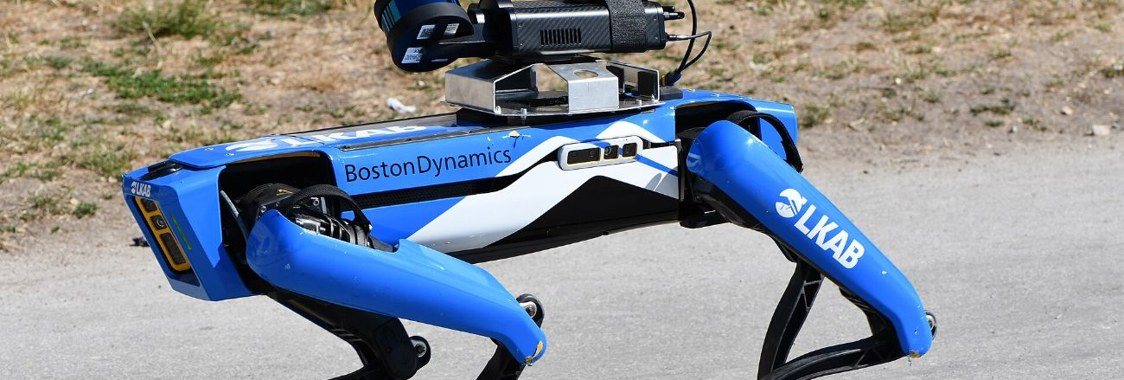
Spot runs mapped routes, mostly overnight, with a 360 camera compared to BIM.
Piling
Built Robotics' autonomous rigs drive close to 1,000 piles a day at the site.
Drilling
Semi-autonomous overhead drilling from BIM plans; up to 8 hours a charge.
- Spot with a lidar payload
- Photo: Tore Danielsson (Wikimedia Sverige), Wikimedia Commons, CC BY-SA 4.0
The most proven tasks are the repetitive ones that the model already describes.
Spot carrying a laser scanner on a live site.
- A Spot quadruped with a Trimble X7 scanner walks between rebar cages on a building site.
- It repeats the same capture route, so progress can be compared with the model week by week.
- Reality capture is one of the most proven uses of legged robots in construction.
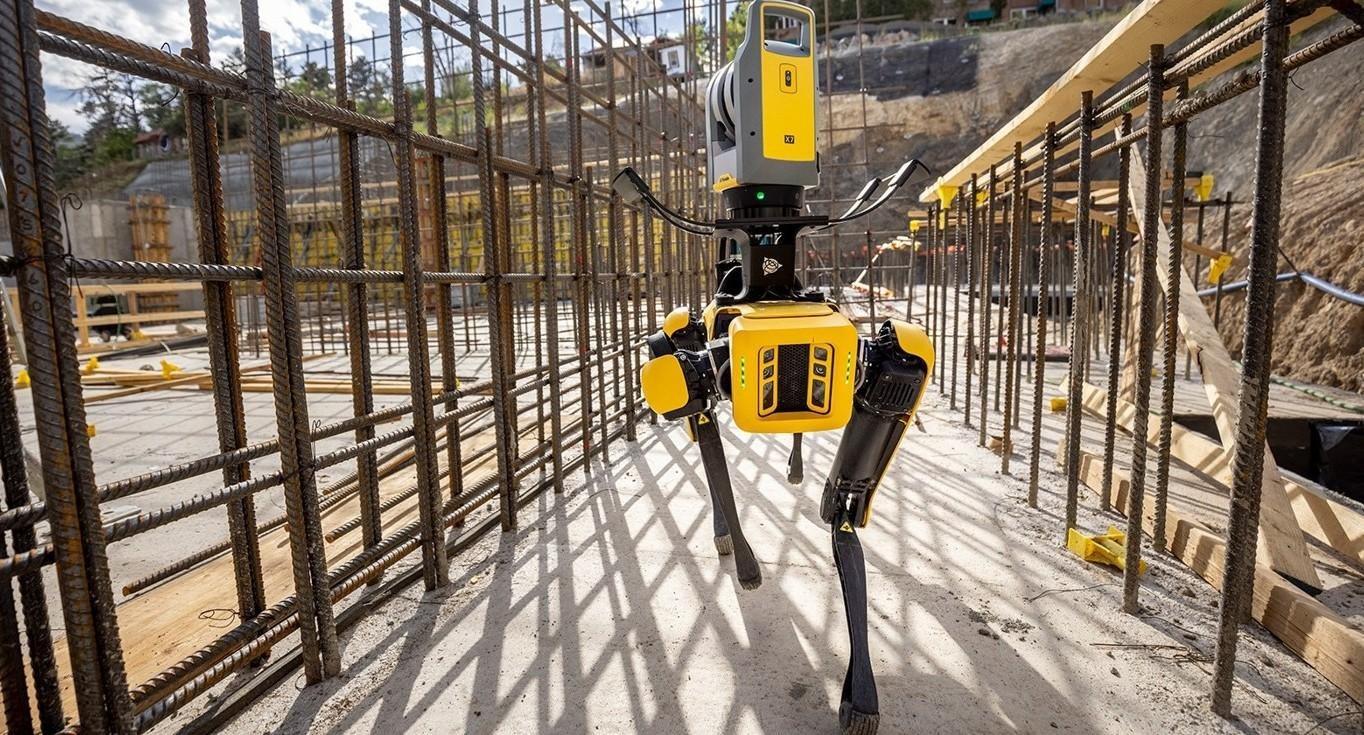
Image: Trimble
Drilling data center slabs is a late pilot.
DEWALT with August Robotics drills rack-stop and hanger holes in concrete.
10x
Faster than manual drilling
80 weeks
Saved across 10 projects in total
99.97%
Accuracy over 90,000+ holes
-69%
Cost per hole, $65 to $20
What it does
Drills holes for server rack stops and for legs that support overhead MEP, as a fleet from a digital drilling plan.
Where it ran
One unnamed hyperscaler across ten phases, announced at World of Concrete in January 2026.
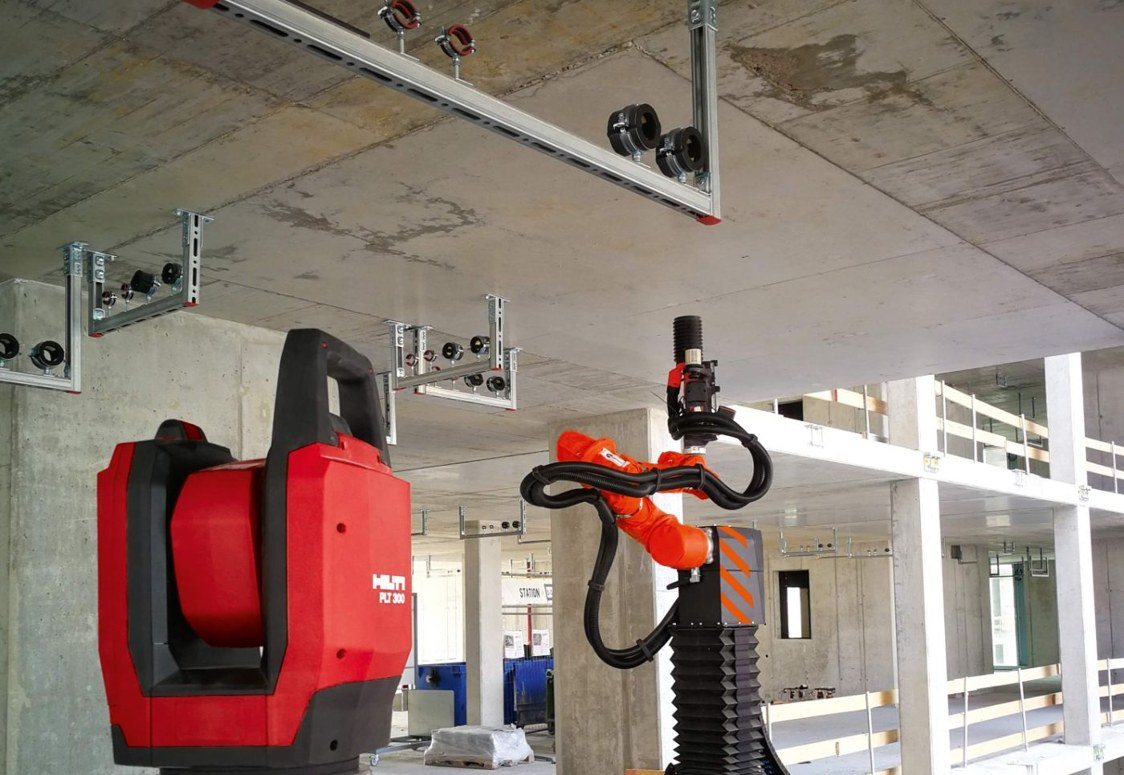
- Hilti Jaibot drilling robot
- Image: Hilti
Same job, other maker
Hilti Jaibot (shown) drills ceilings from BIM plans; it is not the DEWALT robot.
Repeated hole patterns on data hall slabs are an early, clear fit for machines.
Typical ballpark values from public sources, not quotes.
Rebar tying robots are commercial; finishing is earlier.
Bridge decks suit rebar robots; interiors suit finishing robots.
65+
TyBOT field deployments
4M+
Rebar intersections tied by TyBOT
$425,000
TyBOT list price, 67 ft gantry
1M+ sq ft
Plastered by Okibo in Europe
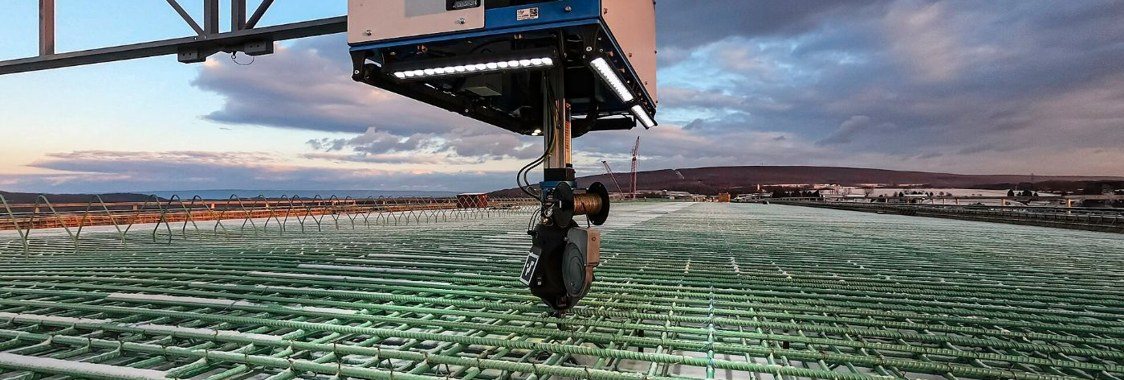
- TyBot tying head above a rebar mat
- Photo: BryceNelson7, Wikimedia Commons, CC BY-SA 4.0
Rebar
TyBOT has a public price and can be bought or hired by the tie. Bridge decks fit best.

Finishing
Canvas and Okibo reach interior walls. Canvas is owned by JLG; Okibo has worked on Netflix House in the U.S.
- Canvas 1200CX drywall finishing robot
- Image: Canvas / JLG
Rebar tying has the longer track record on bridge decks; finishing robots are a step behind.
Typical ballpark values from public sources, not quotes.
Patrol robots are mature at inspection.
Legged robots and wall crawlers run mapped rounds.
Quadrupeds
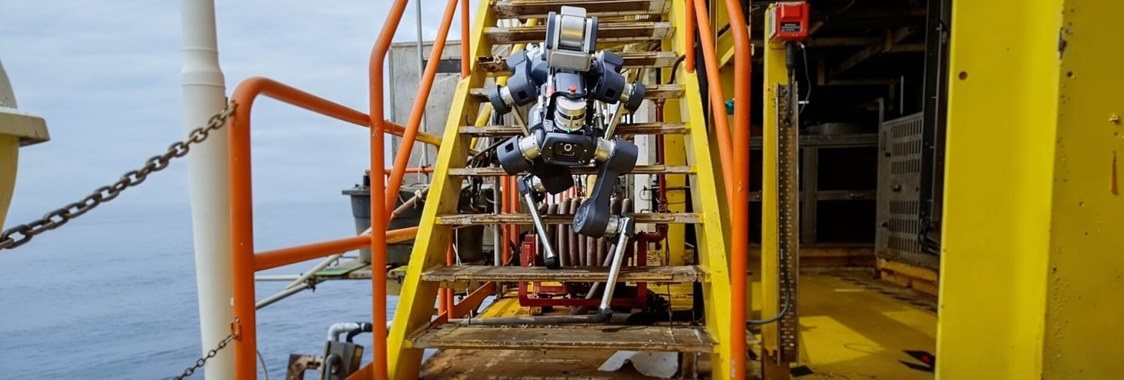
Spot and ANYmal run mapped inspection rounds. ANYmal has one long-running data center inspection site. Proven at inspection, not at manipulation.
- ANYmal X on an offshore platform stairway
- Photo: Cvoellmy / ANYbotics, Wikimedia Commons, CC BY-SA 4.0
Crawlers
Wall crawlers such as Gecko measure steel vessels and pipes in industrial plants.
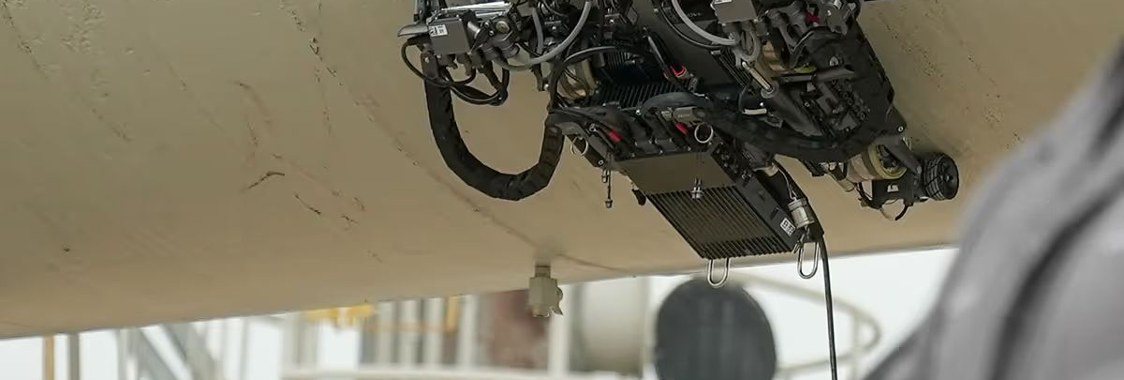
- Gecko crawler on a steel vessel
- Image: Gecko Robotics
Plan on proven tasks now, and pilot the early ones where the upside is large.
Humanoids are early: pilots, not production fleets.
About 13,000 shipped worldwide in 2025 (Omdia); IFR counts about 7,000 full-size units.
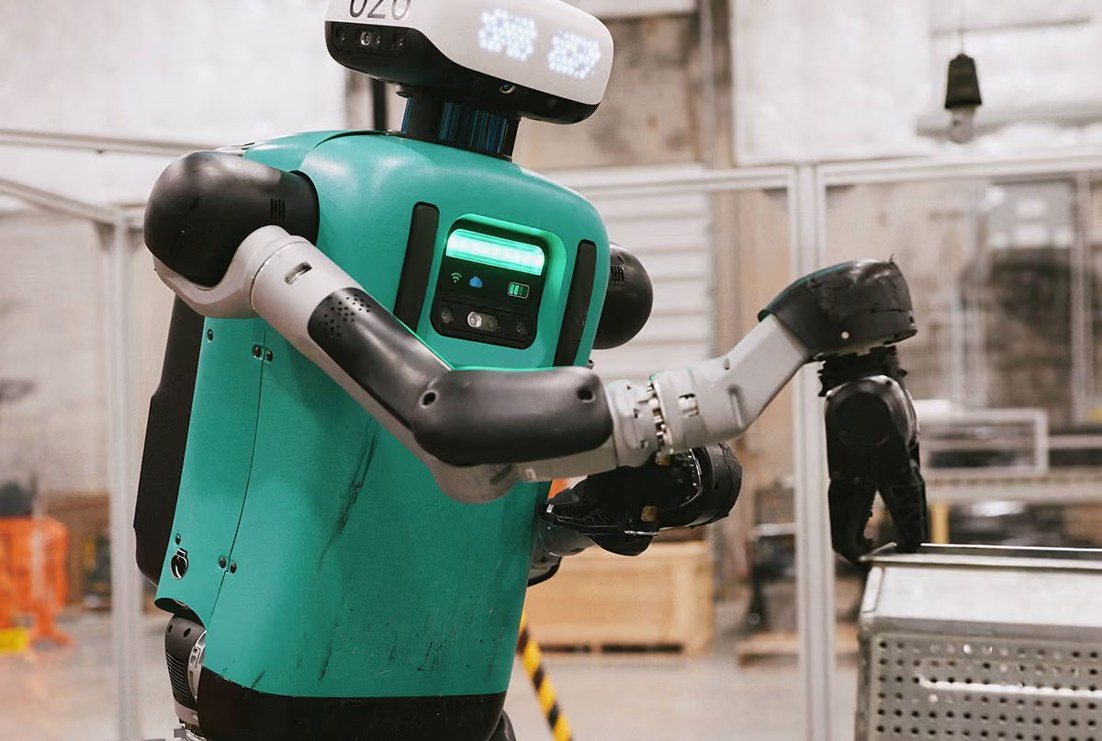
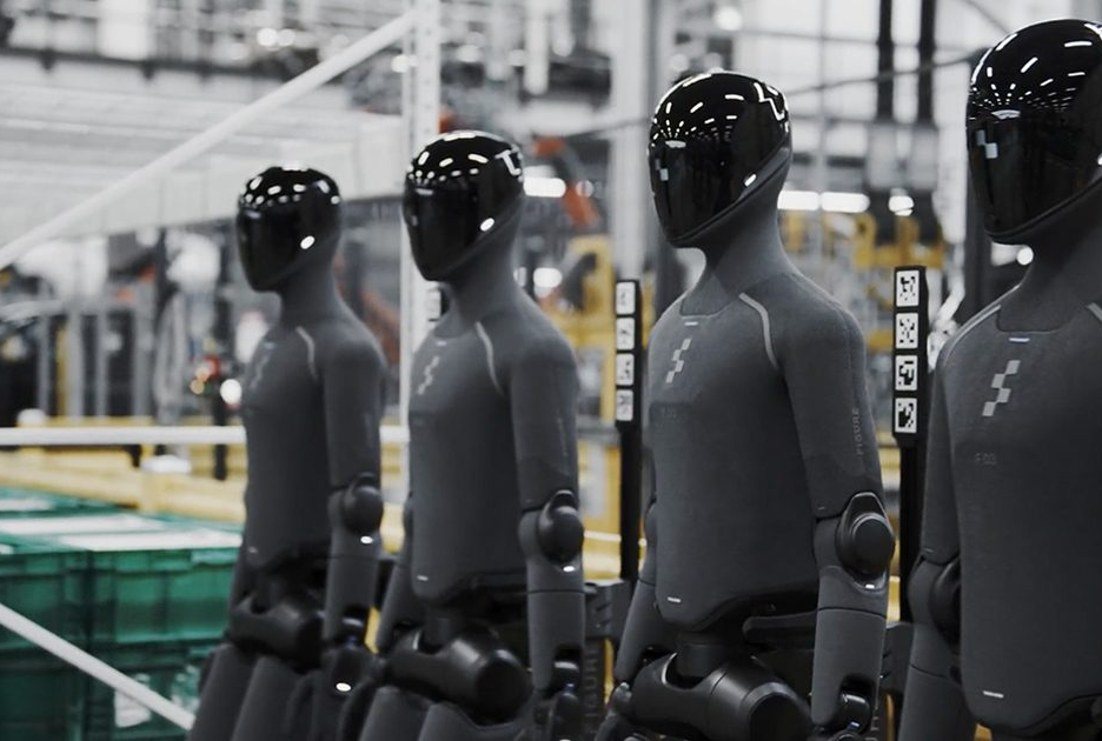
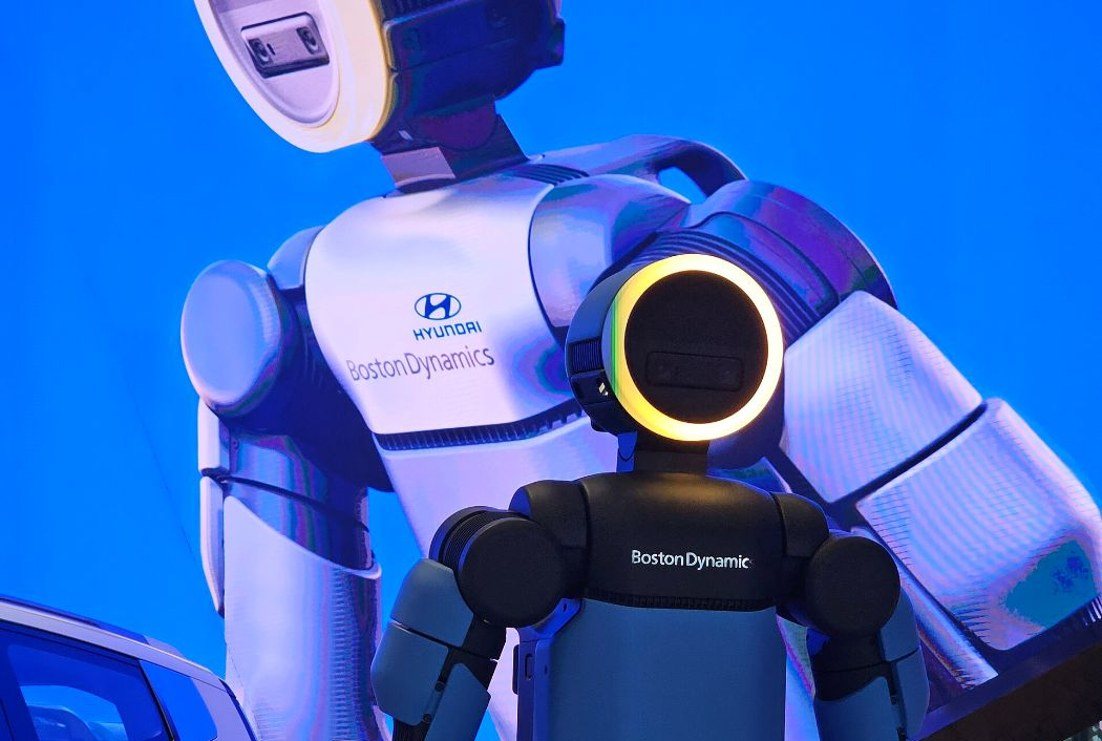
Treat humanoids as pilots for now: production work goes to proven robot classes, and their safety standard is still a draft.
A fair read of the evidence.
What you can rely on, and what to test before you commit.
Strong
Layout, overhead drilling, progress capture, rebar tying, remote demolition, solar piling and inspection patrols.
Reported by makers
Speed, cost-per-unit and accuracy figures come mostly from the makers. Test them on your site.
Thin
Independent productivity studies are scarce, and some early pilots only broke even.
Early
Humanoid factory work, rack-side robots and bricklaying are pilots and plans.
A short pilot with agreed metrics turns a maker's claim into your own result.
2.3 The economics
How machines are acquired, what they cost, and how risk moves.
Five ways to acquire a robot
65
Budget at least three times
67
Prices span about 31 times
66
Pay for capacity and outcomes
68
Five ways to acquire a robot shift risk differently.
Who owns the machine, how payment works and who carries the risk.
| Model | Who owns it | How you pay | Published example |
|---|---|---|---|
| Buy | You | Cash or loan, plus software and support | Digit: about $200,000 hardware |
| Lease | Lessor, or you at buyout | Fixed monthly, often 36 to 60 months | $130,000 robot: $2,549 a month (2022) |
| Rent | Vendor | By the day, week or month | Cyphra rover: $200 a day or $1,800 a month |
| Robot as a service | Vendor | Fixed monthly fee, software and maintenance bundled | Digit: $8,500 a month plus deployment |
| Outcome-based | Vendor | Per hour, tie, hole or day | TyBOT service priced per tie |
Rent and service models move obsolescence and upkeep to the maker. Buying keeps them with you.
Typical ballpark values from public sources, not quotes.
Prices span about 30 times, and many are not disclosed.
Reported and list prices by class, 2026. Typical ballpark values from public sources, not quotes.

| Robot class | Buy (list or reported) | Rent, lease or service |
|---|---|---|
| Unitree G1 humanoid | $13,500 to $27,990 | Lease $3,000 to $15,000 a month (one lessor) |
| Agility Digit | About $200,000 to $250,000 | $8,500 a month plus about $25,000 deployment |
| Figure, Apptronik, Atlas, Optimus | Not publicly disclosed | Not publicly disclosed |
| Spot quadruped | $74,500 (2020); above $100,000 as set up for jobsites | Not published |
| Layout robots (Dusty, HP SitePrint) | Not itemized | Dusty $2,500 to $5,000 a month plus fees; HP $1,500 to $2,000 |
| Drilling (Hilti Jaibot) | No sticker price; $300,000 loss charge | Over $10,000 a month |
| Rebar tying (TyBOT) | $425,000 (67 ft) to $455,500 (117 ft) | Priced per tie |
- Unitree G1 humanoid
- Photo: Sayanesy, Wikimedia Commons, CC0
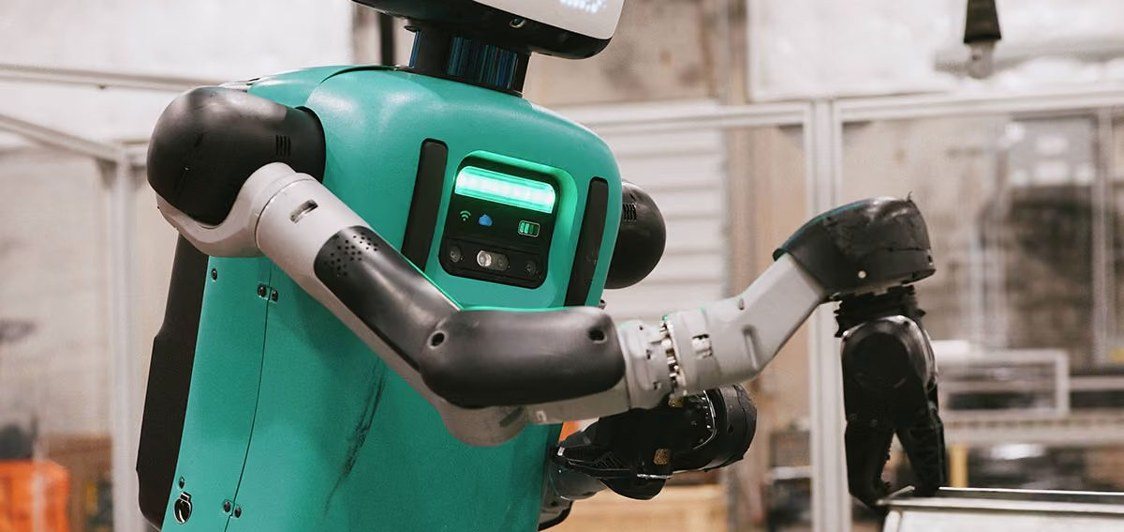
- Digit handling a stacked tote
- Image: Agility Robotics
Budget at least three times the machine price.
A BCG-cited rule of thumb: three times for a robot, four to five for a larger overhaul.
Acquire
Purchase or lease, deployment fee, training and setup, freight, duty, financing and insurance.
Integrate
Installation, segregated work areas, backup power and network, BIM and survey prep, charging space.
Operate
Operators and supervisors, batteries and consumables, training, supervision time and downtime.
Maintain
Maker service plan, wear parts, software fees, spare batteries and controller refresh.
Risk and exit
Insurance with little history, residual value, tax treatment and vendor failure.
Example
A $65,000 six-axis robot implies a budget of about $195,000 once everything is counted.
Owners who price only the machine are surprised. Atomgigs prices the whole scope.
Typical ballpark values from public sources, not quotes.
Atomgigs takes the machine risk off your balance sheet.
How the service model compares with buying a robot.
- Capital outlay up front.
- You carry upkeep, obsolescence and vendor risk.
- You hire and train operators.
- One maker, one task.
Buying a robot
- No capital outlay for machines.
- No long-term headcount.
- A senior pod and named manager per robot.
- The right maker for each task.
With Atomgigs
- Capacity: a crew or a robot by the month.
- Outcomes: work completed, per unit.
- Pilot: a fee based on the scope estimate.
- Structure is agreed case by case.
What you pay for
Start with a pilot, move to a managed crew, and shift to outcomes as machines earn it.
2.4 Safety, standards and liability
How a robot is made safe on a live site, and who answers for what.
Six steps to a safety case
70
Liability follows the role
72
No robot rule from OSHA
71
Standards still being written
73
A site safety case is built in six steps.
Typical sequence for a robot on a construction or data center site.
Define and assess
Specify tasks, site and zones, then run a task-based risk assessment under ISO 12100 and RIA TR R15.306.
Reduce and validate
Design out hazards, add guarding and stops, test stability and batteries, and seek third-party inspection.
Authorize and operate
Train staff, integrate lockout and tagout, log incidents, and re-validate after every change.
Site factors
Data centers: raised floors, energized gear, gas suppression. Construction: layouts that change daily.
Atomgigs builds the safety case with the site team, and keeps stop-work authority in the pod.
OSHA has no robot rule, so general duties apply.
Consensus standards set the benchmark.
Robot-specific OSHA standards
U.S. robot-related deaths, 1992 to 2017 (NIOSH)
Federal OSHA
Machine guarding, lockout and tagout and the General Duty Clause apply. Standards like R15.06 are consensus, not OSHA rules.
On a shared site
Several employers can share duties, and owners add contract rules above OSHA minimums.
Write the robot rules into your site safety plan and your contracts.
Liability follows the role each party plays.
General framework for U.S. deployments.
Manufacturer
Product liability for design, manufacturing and warning defects, including software behavior.
Integrator
System design, guarding and the application risk assessment under ISO 10218-2 and R15.06.
Operator and employer
The OSHA duty and workers' compensation exposure. Some claims can shift to the maker or integrator.
Contract and cover
Indemnities, additional-insured status and waivers of subrogation. Cover to carry: general, products, E&O, cyber and property.
Atomgigs acts as integrator and operator, so the safety case and the duty sit with one team.
Humanoid standards are still being written.
Plan for rules to arrive during your project.
Draft standard
ISO 25785-1 for legged robots was still a draft in October 2026, and assumes level ground.
Europe
EU rules for machinery and AI arrive in 2027, which affects robots built or sold there.
China
China has set a standards map for humanoids, and makers there lead on unit volume.
Cyber and privacy
Connected robots add network, data and camera exposure. Settle data rights and network design up front.
Choose proven robot classes for production work, and treat humanoids as pilots.
2.5 Readiness
What your site, data and contract need before a machine arrives.
A robot is only as ready as the site
75
Ten points before signing
77
Four gates
76
A robot is only as ready as the site is.
Six things to settle before a machine arrives.
Survey control
Control points and a model accurate enough for layout and drilling to rely on.
Network and power
Coverage for fleet management, charging areas and backup power.
Space and staging
Open areas, dock space, lay-down and routes that machines can use.
Named people
Operators, technicians and a manager for each robot, trained before mobilization.
Systems links
BIM, scheduling and reporting connections scoped and tested.
Safety case reviewed
Zones, stops, battery areas and rules agreed with the owner and insurer.
Atomgigs runs a site readiness check in the first week of every pilot.
Decide in four gates before any rollout.
A yes to every item clears the gate. Open items become contract terms.
- 1Task fit
1 Task fit Is the task repeated and well defined? Is the model accurate? Is the robot class mature enough?
- 2Economics
1 Task fit Is the task repeated and well defined? Is the model accurate? Is the robot class mature enough?
- 3Readiness
2 Economics Is manual cost per unit baselined? Is use at two shifts or more? Does payback hold at 60% of maker claims?
- 4Contract
2 Economics Is manual cost per unit baselined? Is use at two shifts or more? Does payback hold at 60% of maker claims?
- 3 Readiness
- Are survey, network and charging planned? Are operators named? Is the safety case reviewed?
- 4 Contract
- Are uptime and response times defined? Who owns the data? Is exit or buyback priced?
A pilot answers gates one to three. The contract answers gate four.
Ten points to settle before signing.
A checklist drawn from the terms and gaps found in public sources.
Model in writing
Price, deployment fee, software, support, term and renewal.
Delivery has a date
A remedy for late delivery.
Uptime is defined
Measurement, response time and credits.
Loss and damage allocated
Insured amounts stated.
Safety evidence on file
Risk assessment and certification status.
Data rights settled
Ownership, no model-training reuse, deletion on exit.
Vendor failure planned
Escrow, step-in rights, spares.
Service location checked
Technician location and response time.
Trade exposure mapped
Origin, tariff class and parts sourcing.
Tax and insurance advice
Lease class, expensing and a broker quote.
What Atomgigs does for you
What Atomgigs is, services, beyond the robots, the commercial model.
3.1 What Atomgigs is
The gap in the market, and how Atomgigs fills it.
The gap
What Atomgigs is
80
81
How it works
Four phases
82
83
Robot makers sell machines. Your clients need finished work.
Between the factory and the finished site sits a layer nobody owns.
- Machines, as units or per-hour service.
- Focused on product, funding and scale.
- Few field and integration teams.
- Support for the machine, not the project.
Robot makers sell
- Who selects and sources the right robot?
- Who integrates it into the site workflow?
- Who trains, supervises and keeps it running?
- Who staffs the people beside it, and answers when the schedule slips?
The gap
- Work finished on schedule and to specification.
- Skilled people they cannot find.
- Safety and compliance on a live site.
- One responsible party, not five vendors.
Your clients need
Atomgigs fills the gap: the team that scales your build with machines and people, and stays to operate.
One hybrid workforce, delivered as a service.
Robots, specialized labor and site leadership, to scale your build and then operate it.
- An integrator of robots and people.
- A direct sourcer of robots from their makers.
- A source of vetted specialized labor.
- The lead on site, with a named human manager for each robot.
- An advisor to makers and investors.
We are
- A robot manufacturer.
- A staffing agency alone.
- A general contractor of record.
- Tied to any one robot brand. We match the robot to the task.
We are not
- One team and one contract.
- Robots where they work, people where they must be.
- A start with people that shifts as robots mature.
- Pay for capacity and outcomes, not hardware.
You get
Robots from their makers. People from our network. One team on site.
Source, staff, integrate, scale and operate.
We assemble everything to scale your build and operate with people and robots.
Source the robots
We contract robots directly with their makers, light to heavy, and match the robot to the task, not the brand.
Bring the people
Vetted skilled labor and supervisors from our partners, trained to work beside robots and ready to start fast.
Put them to work together
Site mapping, task design, tooling, safety and fleet operations, run by one small pod with a named manager for each robot.
Scale and operate
One team, one contract and weekly reporting. The mix shifts toward robots as they prove safe, reliable and cheaper.
Humans in the lead, physical AI in the loop.
Robots take more of the load as they prove out.
You get capacity from day one; the robot share grows as it proves safe, reliable and cheaper.
- 1Human crews
Phase 1: Human crews Specialized trades placed fast, labor partners vetted, safety and quality managed. Robots limited to pilots.
- 2Robot-assisted
Phase 1: Human crews Specialized trades placed fast, labor partners vetted, safety and quality managed. Robots limited to pilots.
- 3Hybrid crews
Phase 2: Robot-assisted Robots take repetitive tasks such as layout, drilling, tying and hauling. Humans supervise and finish.
- 4Robot-led
Phase 2: Robot-assisted Robots take repetitive tasks such as layout, drilling, tying and hauling. Humans supervise and finish.
Phase 3: Hybrid crews
Mixed crews by design. Robots do the dull and dangerous work; humans do the judgment work.
Phase 4: Robot-led
Robots at scale across sites. Humans as supervisors and technicians: fewer people, higher skill.
We never move faster than safety permits.
3.2 Services
Eight services, the site pod and the weekly report.
Eight services
85
The weekly report
87
The site pod
86
Everything the hybrid workforce needs, plus advice.
Buy the full package or pick the pieces.
Robot sourcing
Select and contract the right robots from many makers, on service or purchase terms.
Specialized labor
Vetted electricians, pipefitters, technicians and supervisors, on demand and at scale.
Integration and site engineering
Site mapping, task design, tooling, networks, charging, staging and handoffs.
Safety and compliance
Safety cases, training, supervision and incident response for people and machines on a live site.
Fleet operations
Deployment, monitoring, maintenance and uptime, including remote operations support.
Data and reporting
Productivity, progress and safety data captured by the fleet and reported weekly.
Robot maker advisory
Go-to-market and positioning for makers: use cases, buyers and first deployments.
Investor advisory
Diligence, portfolio tracking and board-level support for investors in physical AI.
For you, the first six are the core. The last two matter when your clients are makers or investors.
A pod, not a pyramid.
A small senior pod runs each site, from build to operations.
Site pod lead
Single point of contact. Owns schedule and outcome. Interface to the owner and the general contractor. Weekly reporting.
Robotics lead
Chooses robots per task, runs integration and tooling, coordinates makers and keeps the fleet up.
Skilled crew
Trades from labor partners who work beside robots, with a foreman on every shift.
Safety and compliance
Site safety plan, human-robot zoning, training and certification, and stop-work authority.
Remote operations and data
Fleet monitoring, progress capture, owner dashboards and remote assistance.
Right-sized
Scaled up or down as the work changes. A human manager is assigned to each robot.
You deal with one pod lead. The pod deals with machines, crews and data.
The weekly report tells you where the work stands.
Delivered to you and, where agreed, to your client.
Output
Work completed by task, against plan and against the manual baseline.
Progress against the model
Scans compared with the design, with deviations flagged.
Safety
Observations, near misses, stops and open actions.
Uptime and interventions
Machine availability and how often a person had to step in.
Issues and decisions
What is blocking work and what is needed from you or the owner.
Next two weeks
Planned areas, crew and machine changes, and the measures to watch.
Reporting is what lets a pilot become a decision.
3.3 Beyond the robots
Equipment, automation, IoT and digital twins.
Equipment
89
Digital twins
91
Automation and IoT
90
Atomgigs coordinates the large equipment your build needs.
Working with makers, distributors and end users.
Data center power
Transformers, switchgear, generators and UPS.
Cooling
Chillers and liquid cooling.
Large automation products
Transducers and control systems at scale.
Submittals and testing
Specifications, submittals and factory acceptance tests.
Delivery and rigging
Heavy-haul delivery, rigging, pads and lay-down.
Installation and commissioning
Installation, utility interconnection and commissioning, with one team coordinating makers, distributors and the end user.
A single coordinator shortens the chain between the maker and the energized system.
Everything automation, from one sensor to a full system.
Atomgigs designs, integrates and commissions site automation.
Sensors
IoT sensors for power, temperature, flow, leaks and vibration.
Edge and controls
Controllers, gateways and edge devices.
Building systems
Building management, power monitoring and SCADA integration.
Open protocols
Many vendors working together without lock-in.
Network and cyber
Network and cybersecurity design for site devices.
Feeds the twin
Sensor data updates the digital twin of the site.
Automation extends the same pod and data from construction into operations.
A digital twin is a living copy of the site.
It links design, construction and operations in one model.
- Model a project before breaking ground.
- Layout, power, cooling, equipment fit and work sequence.
- Test the schedule with robot capacity included.
Plan
- Update the model with as-built scans.
- Compare plan with actual, weekly or daily.
- Direct machines from the same model.
Build
- Hand the owner an as-built twin.
- Feed it with sensor and patrol data.
- Use it for maintenance and change planning.
Operate
Your VDC and BIM team already hold the model. Atomgigs connects it to the field.
3.4 The commercial model
Start small, pay for capacity and outcomes, and scale as machines earn it.
Start small
93
Structure and fees
95
What it means for you
94
Start small, and scale as results are proven.
Pay for capacity and outcomes, with no capital outlay for machines and no long-term headcount.
- 1Pilot
Pilot One defined scope, four to eight weeks. A mixed crew with one or two robot tasks and agreed success metrics. Fee based on Atomgigs' estimate of the scope.
- 2Managed crew
Pilot One defined scope, four to eight weeks. A mixed crew with one or two robot tasks and agreed success metrics. Fee based on Atomgigs' estimate of the scope.
- 3Outcome-based
Managed crew A hybrid crew on retainer, from build to operations. Monthly fee per crew or per robot, with flex on notice and weekly reporting.
- 4Advisory
Managed crew A hybrid crew on retainer, from build to operations. Monthly fee per crew or per robot, with flex on notice and weekly reporting.
Outcome-based
Paid for work completed: priced per unit of finished work, with shared savings against baseline and multi-site master agreements.
Advisory
Scoped engagements for expertise: pilot design, supplier selection, safety case review, and business cases.
Start with a pilot, move to a managed crew, and shift to outcomes as the robots earn it.
What the model means for a partner.
Terms that keep your balance sheet and your client relationship intact.
No capital outlay
You and your client do not buy machines. Atomgigs sources them from the makers.
No long-term headcount
Crews and supervisors flex up and down with the work.
Low commitment to start
A pilot is scoped, time-boxed and priced from the scope estimate.
One contract
One team and one agreement for the machines, the people and the result.
Your client stays yours
You choose how visible Atomgigs is, from a named trade partner to a white-label capability.
Flexible structure
Each deal is shaped to your contract, your client and your risk position.
Chapter 4 sets out the ways to work together in detail.
Value sharing is structural; fees are set case by case.
The building blocks of an agreement.
Capacity fee
A monthly fee for a crew or a robot, with the scope and flex terms written in.
Outcome fee
A price per unit of finished work, or shared savings against an agreed baseline.
Pilot fee
A fee based on Atomgigs' estimate of the scope, agreed before mobilization.
Teaming and referral terms
How pursuit effort, work share and introductions are recognized between you and Atomgigs.
Specific terms are negotiated for each engagement.
Ways to work with Atomgigs
Seven ways at a glance, teaming and subcontract, referral and white-label, master agreement and bim/vdc, advisory.
4.1 Seven ways at a glance
How the models compare, and how to choose.
Seven models compared
98
What you keep
100
Choosing a model
99
Seven ways to work with Atomgigs.
Who holds the contract, and how visible Atomgigs is to your client.
| Model | Who holds the client contract | Atomgigs visible? | Best when |
|---|---|---|---|
| Teaming | You and Atomgigs, as a team | Yes, named | Pursuing a project where machines help win |
| Subcontract | You; Atomgigs holds a subcontract | Yes, as a trade | Machine scope is awarded and needs a trade partner |
| Referral | Atomgigs, directly with your client | Yes | You want to introduce, not manage |
| White-label | You, under your brand | As you choose | You want it as your own capability |
| Master agreement | You, with task orders | As you choose | Repeat work across projects or sites |
| BIM and VDC integration | Follows the model chosen | Technical layer | Your model must drive the machines |
| Advisory | You hold an advisory agreement | No | You need expertise before committing |
Models combine: many partners start with advisory and move to subcontract.
Start from your question, then choose the model.
A quick guide for partners.
| If your question is | Start with |
|---|---|
| Can machines help us win this pursuit? | Teaming |
| We won the work and need a machine trade. | Subcontract |
| Our client asks about robots and we do not want to run them. | Referral |
| We want to offer physical AI under our own name. | White-label |
| We will use machines on many projects. | Master agreement |
| Our model has to feed layout, drilling and scanning. | BIM and VDC integration |
| We are not sure where machines fit. | Advisory |
If two fit, choose the lighter one first. You can move to a deeper model as results appear.
Whichever model you choose, you keep your position.
What stays with you, and what Atomgigs brings.
- The client relationship and the prime contract.
- Control of scope, schedule and site access.
- Your brand, where you choose.
- Your standards for quality and safety.
You keep
- Machines sourced from many makers.
- Vetted skilled labor.
- A senior pod and a named manager per robot.
- Safety case, fleet operations and weekly reporting.
Atomgigs brings
- A clear scope boundary and handoffs.
- Data and reporting rights.
- Insurance and indemnity terms.
- A decision gate before scaling.
Shared
The agreement shapes who sees what. It does not change who leads your client.
4.2 Teaming and subcontract
Pursue together, or engage Atomgigs as a machine trade.
Teaming
102
Roles and handoffs
104
Subcontract
103
Teaming: pursue together and win together.
A teaming agreement covers a specific pursuit, from qualification to award.
What the agreement covers
The pursuit, each side's role, work split, confidentiality and exclusivity for that project.
What Atomgigs adds to the pursuit
A machine scope, a labor plan, a safety approach and a price from its own estimate, ready for your proposal.
After award
The teaming agreement converts to a subcontract or services agreement on the terms agreed up front.
If you do not win
Each side bears its own pursuit cost unless agreed otherwise. Terms are set case by case.
Teaming works best when machines are part of your win themes, not an afterthought.
Subcontract: Atomgigs as your machine trade.
Atomgigs staffs, equips and operates a defined scope under your prime contract.
Scope
A defined machine scope: layout, drilling, tying, finishing, scanning, hauling or inspection.
Price
Capacity or unit-based, from Atomgigs' estimate of the scope.
Schedule
Mobilization, working areas and sequencing tied to your master schedule.
Safety flow-down
Your site safety plan applies. Atomgigs adds its robot safety case and training.
Insurance and indemnity
Cover and indemnities that match your prime contract requirements.
Payment
Terms that match your own billing cycle with the owner.
A machine scope is a specialty subcontract, not a new type of contract.
Who provides what in a subcontract.
A typical split of responsibilities on a machine scope.
| Item | You | Atomgigs |
|---|---|---|
| Site access, utilities, working areas | Provide | Plan use |
| BIM, control points and survey data | Provide | Check and prepare |
| Site safety plan and orientation | Own | Add robot safety case and training |
| Machines, batteries and charging | - | Source and operate |
| Crew, supervisors and managers | - | Provide |
| Permits and owner approvals | Lead | Support |
| Reporting to the owner | Lead | Supply data and weekly report |
Handoffs are written into the subcontract so there are no gaps on site.
4.3 Referral and white-label
Light-touch models that keep the client relationship with you.
Referral
106
Compare the light models
108
White-label
107
Referral: you introduce, Atomgigs delivers.
The lightest model. Your client contracts with Atomgigs directly.
How it works
You introduce a client with a physical AI need. Atomgigs scopes, proposes and contracts with the client.
Your role
Make the introduction and stay in the conversation as the trusted advisor you already are.
Atomgigs' role
Run discovery, scope, pilot and delivery, and keep you informed.
Recognition
How referrals are recognized is agreed in writing before the introduction.
Good for firms that do not want to carry machine scope on their own contract.
White-label: physical AI under your own brand.
You offer the capability. Atomgigs delivers it behind you.
How it works
You sell and contract the scope with your client. Atomgigs staffs, equips and runs it in your name.
Your role
Own the client relationship, the contract and the presentation of results.
Atomgigs' role
Source machines, supply crews, run operations and supply reporting data to you.
Guardrails
Agree safety responsibility, insurance, data rights and credit before the first project.
Good for firms building a physical AI practice without building the team.
Subcontract, referral and white-label side by side.
The three models differ in who sees what.
| Subcontract | Referral | White-label | |
|---|---|---|---|
| Client contract with | You | Atomgigs | You |
| Atomgigs seen by client | As a named trade | Yes | As you decide |
| Who carries delivery risk | Shared by contract | Atomgigs | Shared by contract |
| Effort for you | Moderate | Low | Moderate to high |
| Good first step | Yes | Yes | After a pilot |
Pick the one that fits your risk appetite and your client's expectations.
4.4 Master agreement and BIM/VDC
Move fast on repeat work, and connect the data.
Master agreement
Terms to set once
110
111
BIM and VDC
Data both ways
112
113
A master agreement lets you move fast on repeat work.
Settle the terms once, then issue a task order for each project.
Master terms, once
Safety, insurance, data rights, rates or pricing structure, reporting and dispute handling.
Task orders, each time
Project, scope, duration, crew and machines, success measures and fees.
Why it helps
Pursuit-to-start time falls, and your team gets a repeatable pattern across sites.
Good for
Data center programs, multi-site builders, and framework contracts with owners.
A master agreement turns a pilot result into a repeatable program.
Terms worth settling in the master agreement.
Settling these once saves weeks on every project.
Safety and standards
Which safety case, training and site rules apply to every task order.
Insurance and indemnity
Cover levels, additional-insured status and who carries machine loss.
Data and IP
Who owns site data and models, no reuse for model training, deletion on exit.
Commercial structure
Capacity or unit pricing, flex terms, and how outcome measures are set.
Reporting
Weekly report format and the metrics that every project uses.
Exit and continuity
Notice, demobilization and what happens if a maker fails.
Many owners already have framework terms. Atomgigs can work within them.
BIM and VDC integration: what the model must carry.
Machines can only follow a model that is complete and trustworthy.
Coordinates and control
A shared coordinate system and survey control points on the slab or structure.
Levels and tolerances
Floor flatness, tolerances and as-built accuracy that layout and drilling robots can rely on.
Element detail
Hangers, sleeves, anchors and rack positions modeled where machines will work.
Tags and quantities
Identifiers that link each element to tasks and progress reports.
Version control
One current model, with changes issued to the pod when they happen.
Coordination status
Clashes resolved in the area before machines start.
Atomgigs reviews the model with your VDC lead before a pilot begins.
Data flows both ways between your model and the machines.
The model directs the machines, and the machines update the model.
Model to machine
Points, holes and areas are exported from the model to layout, drilling and tying robots.
Machine to model
Scans and as-built data return, deviations are flagged, and the model is updated.
Your team keeps control
Your VDC lead approves what is exported and what is accepted back.
One thread
The same data runs from design through construction into the owner's twin.
Your BIM and VDC team becomes the control room for machine work.
4.5 Advisory
Atomgigs as your advisor on physical AI.
Advisor
115
Engagement path
116
Atomgigs as your advisor on physical AI.
Use the expertise before you commit to a machine scope.
Technology scan
Which robots, drones and sensors fit your project types, and at what level of proof.
Pilot design
Scope, baseline, success metrics and decision gates for a first trial.
Supplier selection
Shortlists and comparisons across makers, terms and support.
Safety case review
A review of the site safety approach for people and machines.
Business case
Cost of ownership, service models and payback at conservative assumptions.
Pursuit support
Win themes, proposal language and pricing structure for machine scopes.
Advisory is often the first step, and carries no obligation to deploy.
Advice leads to a pilot and then to production.
The path from a first conversation to a repeatable program.
Consulting engagement
Scope the opportunity, design the pilot and agree the success measures.
Pilot
Four to eight weeks on a live scope with a mixed crew and one or two robot tasks.
Production
A managed crew or outcome-based work, scaled across areas and sites.
At every step
You can stop, adjust or scale. Decision gates are written in from the start.
Chapter 7 shows how to start.
By firm type
Engineering firms, design and architecture firms, mep and specialty contractors, general contractors and builders, construction and program managers.
5.1 Engineering firms
Why engineers matter most, and what they gain.
Why engineers matter most
119
New service lines
122
What engineers add
120
Pilot package: engineering
123
By discipline
121
Talking to the owner
124
Engineering firms shape what machines can do.
Engineers set specifications, standards and performance criteria, early and with authority.
They write the requirements
Specifications and performance criteria decide whether a machine scope is allowed, required or ignored.
They are trusted advisors
Owners turn to their engineers first on technical risk, so a recommendation carries weight.
They see the whole system
Structural, electrical, mechanical and civil design meet in the engineer's model.
They own the standards link
Codes and consensus standards, including robot safety standards, pass through engineering review.
If engineers write machine scopes into the design, owners get them. If not, they arrive late.
Where engineers add value with physical AI.
Six places an engineering firm can lead.
Reality capture
Drone and scan surveys give a measured model of existing conditions before design hardens.
Robot-ready design data
Coordinates, tolerances and tags that layout, drilling and tying robots read directly.
Constructability for machines
Access, reach, flatness, power and the open area a robot needs, reviewed at design stage.
Performance criteria
Specifications written around measured outcomes, not methods, so machines can qualify.
Safety case input
Engineering review of zones, loads, battery areas and energized equipment.
Commissioning data
Automated as-built scans and sensor data that support testing and handover.
Atomgigs supplies the field evidence that makes these specifications practical.
What each engineering discipline gains.
Examples of physical AI use by discipline.
| Discipline | Where physical AI helps |
|---|---|
| Civil and site | Drone survey, volumes, autonomous layout, earthmoving and piling kits |
| Structural | Rebar tying, anchor drilling, as-built verification against the model |
| Electrical | Overhead drilling, cable-tray and equipment layout, inspection of energized rooms |
| Mechanical and plumbing | Hanger and sleeve layout, ceiling drilling, leak and thermal inspection |
| Controls and automation | Sensor networks, SCADA and building system integration, digital twins |
| Geotechnical and environmental | Aerial mapping and monitoring, remote sensing, hazardous-site inspection |
A discipline lead can find a use in their own scope within minutes.
New service lines for engineering firms.
Physical AI creates paid work that suits an engineering practice.
Feasibility studies
Where machines can help on an owner's portfolio, with proof levels and costs.
Constructability reviews
Design reviews for machine access, tolerances and model quality.
Owner's engineer for machine scopes
Specify, evaluate and oversee machine work on the owner's behalf.
Performance monitoring
Independent measurement of output, accuracy and safety on pilots.
Atomgigs supports each as an expert partner, so your team gains skills as it sells.
A pilot package for engineering firms.
Four to eight weeks, one defined scope, agreed success metrics.
Scope options
Reality capture of one site, a robot-ready model for one floor, or a constructability review for one project.
What Atomgigs does
Runs drone or scan capture, reviews the model, and supplies a robot task plan.
What you get
A measured model, a machine-ready design checklist and a short report with metrics.
Decision at the end
Scale to more projects, add a specification section, or stop.
Fee is based on Atomgigs' estimate of the scope.
A conversation to have with your client.
A short path from a worry to a pilot.
- Where are crews short on this project?
- Which tasks are repeated, dull or unsafe?
- How will we know progress is on plan?
Open
- A short pilot on one task, with a baseline.
- Machines and people provided as a service.
- Your engineering team defines the measures.
Offer
- Scope, area and success metrics.
- Who provides access, power and the model.
- A decision gate after the pilot.
Agree
You lead the conversation. Atomgigs brings the machines, people and numbers.
5.2 Design and architecture firms
Making designs buildable and measurable.
What design firms own
126
Working with Atomgigs
128
Where it fits
127
Design and architecture firms own the design intent.
They set the layout, the finishes and the model that everyone builds from.
- Design intent and the model.
- Drawings, specifications and details.
- Coordination with engineers and the owner.
What they own
- Designs that are hard to build to tolerance.
- Rework from field deviations.
- Models that are not used on site.
What worries them
- Measured existing conditions.
- Layout from the model, to the millimeter.
- As-built scans compared with design intent.
What physical AI offers
Machines make the model matter on site.
Where physical AI fits for design firms.
Four moments in a design project.
Existing conditions
Drone and scanner surveys give a measured model for renovation and site design.
Design for machines
Repeated details, clear tolerances and open areas help robots finish interiors and facades.
Construction administration
Scan-versus-model comparisons support site observation and reporting.
Operations
The as-built twin supports the owner's facilities team.
Designing for machines often improves buildability for people too.
How design firms work with Atomgigs.
Light models fit design firms best.
Advisory
Design reviews for machine readiness on one project type.
Referral
Introduce owners who ask about robots and reality capture.
White-label
Offer reality capture as a service under your brand.
Pilot
Capture one site and compare with the model over four to eight weeks.
Start with the model you already have.
5.3 MEP and specialty contractors
The trades where labor is tightest.
What MEP firms own
130
Working with Atomgigs
132
Tasks
131
Pilot package: MEP
133
MEP and specialty contractors carry the labor risk.
Electrical, mechanical, plumbing, fire and telecom trades do most of the repeatable work.
- Installation of systems.
- Crews and foremen.
- Prefab and coordination drawings.
What they own
- Skilled labor, especially electricians.
- Schedule and rework.
- Overhead work and heights.
What worries them
- Drilling and layout robots.
- Machines for hauling and tying.
- Progress data and inspection.
What physical AI offers
Specialty trades grew fastest, and they are where the labor gap bites first.
Repeatable MEP tasks suit machines.
Tasks, machines and maturity.
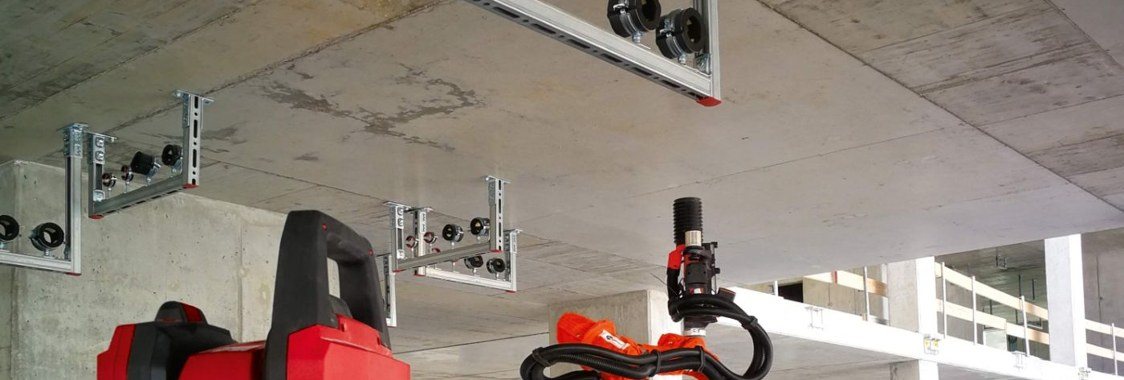
| Task | Machine | Maturity |
|---|---|---|
| Floor layout of sleeves, hangers and equipment | Layout-printing robots | Commercial |
| Overhead drilling for hangers and anchors | Ceiling-drilling robots | Commercial |
| Slab holes for rack stops and supports | Drilling robot fleets | Late pilot |
| Material hauling and staging | Autonomous carts and tuggers | Commercial |
| Progress and quality capture | Spot, drones, scanners | Commercial |
| Cable pulling | No proven robot yet | Not yet |
- Hilti Jaibot drilling robot
- Image: Hilti
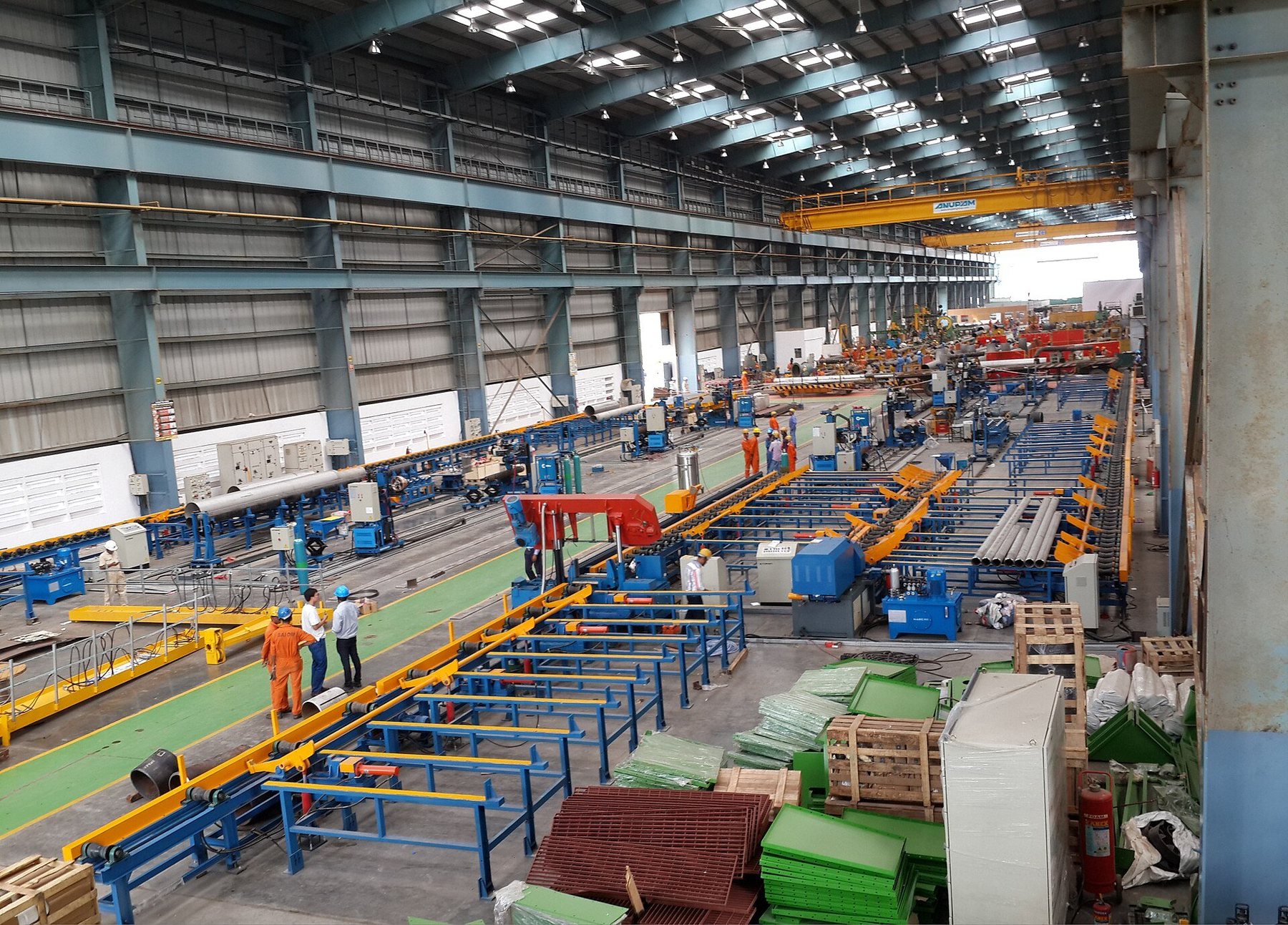
- Pipe spools prefabricated in a shop, off site
- Photo: Belle Tong, Wikimedia Commons, CC BY-SA 4.0
Choose the proven tasks first.
How MEP and specialty firms work with Atomgigs.
Subcontract and master agreement fit best.
Subcontract
Atomgigs as a machine trade on your scope, under your safety plan.
Master agreement
Terms set once for repeat work across your projects.
Teaming
Pursue data center and industrial packages together.
Pilot
One area, one task, four to eight weeks, with a baseline against manual work.
Your crews work beside the machines and keep the skilled work.
A pilot package for MEP and specialty firms.
A typical overhead-drilling or layout pilot.
Scope
One floor or hall: layout and anchor drilling for hangers or rack supports.
What Atomgigs does
Provides machines, operators and a pod lead; prepares the model and control points.
Metrics
Holes or marks per hour against crew baseline, accuracy to model, rework and safety observations.
Decision
Scale to more floors, add a task, or stop.
Four to eight weeks gives you your own numbers.
5.4 General contractors and builders
Schedule, margin and safety.
What GCs own
135
Working with Atomgigs
137
Where it fits
136
Pilot package: GC
138
General contractors answer for schedule, cost and safety.
They hold the prime contract and coordinate every trade.
- The prime contract and the master schedule.
- Trade coordination and site logistics.
- Safety on a live site.
What they own
- Trade shortages and stacked crews.
- Schedule slip and rework.
- Margin under cost pressure.
What worries them
- Capacity that extends beyond a normal shift.
- Daily progress data against the model.
- Fewer people in hazardous work.
What physical AI offers
Backlog is high. Crews are the constraint.
Where physical AI fits in a contractor's project.
From pursuit to closeout.
- 1Pursuit
Pursuit Add machines to win themes: schedule certainty, a labor plan and a safety approach.
- 2Preconstruction
Pursuit Add machines to win themes: schedule certainty, a labor plan and a safety approach.
- 3Build
Preconstruction Build robot capacity into the schedule and price machine scopes early.
- 4Closeout
Preconstruction Build robot capacity into the schedule and price machine scopes early.
Build
Layout, drilling, tying, hauling, finishing and daily capture on the critical path.
Closeout
As-built scans, punch-list evidence and a twin for the owner.
The earlier a GC plans for machines, the more they change.
How general contractors work with Atomgigs.
Teaming, subcontract and master agreement fit best.
Teaming
Win the pursuit with a machine scope in your proposal.
Subcontract
Atomgigs as a trade partner under your prime contract.
Master agreement
Terms for repeat use across your project portfolio.
Pilot
One task on one project, with agreed metrics and a decision gate.
Your project teams keep command of the site.
A pilot package for general contractors.
Four to eight weeks on a live project.
Scope
Layout, drilling or progress capture on one floor or zone.
What Atomgigs does
Pod lead, robots, crew, safety case, and weekly report.
Metrics
Output per hour, days saved on the task, accuracy, safety observations and cost per unit.
Decision
Scale across floors, add tasks, or stop.
A pilot gives your next bid evidence, not just a promise.
5.5 Construction and program managers
Control, reporting and coordination.
What CMs own
140
Working with Atomgigs
142
Where it fits
141
Construction and program managers own control and reporting.
They coordinate owner, designer and builders and report the truth.
- Cost, schedule and quality control.
- Owner reporting.
- Coordination across contracts.
What they own
- Progress they cannot see in time.
- Contractor claims and delays.
- Safety across many contractors.
What worries them
- Daily scan-versus-model progress data.
- Independent measurement of output.
- Evidence for decisions and claims.
What physical AI offers
Capture data is the CM's native language.
Where physical AI fits for construction managers.
Data first, then machines.
Progress capture
Drones and ground scanners produce objective progress against the model.
Quality and deviation
Automated checks flag deviations early, while crews are on site.
Contractor machine scopes
Evaluate and oversee machine scopes that contractors propose.
Reporting and dashboards
Weekly data for owners without extra staff.
CMs can also specify machine scopes in contractor requirements.
How construction and program managers work with Atomgigs.
Advisory and referral fit best.
Advisory
Design a capture program and measure contractor machine scopes.
Referral
Introduce contractors and owners who need machines or capture.
White-label
Offer capture and reporting as part of your management service.
Pilot
Capture one project for four to eight weeks and report against the schedule.
Start with capture and reporting.
5.6 EPC, EPCM and data center builders
Scale, speed and peak labor.
What EPCs own
144
Working with Atomgigs
146
Where it fits
145
Pilot package: EPC
147
EPC, EPCM and data center builders work at scale and speed.
They deliver large industrial, energy and data center programs on tight schedules.
- Engineering, procurement and construction.
- Multi-site programs.
- Large crews at peak.
What they own
- Peak labor, especially electricians.
- Schedule on repeated builds.
- Safety at scale.
What worries them
- Repeatable tasks across sites.
- Machine fleets and standard playbooks.
- Data comparing sites and phases.
What physical AI offers
Repeated designs are where machines pay back fastest.
Where physical AI fits in large programs.
Repeated scopes across many projects.
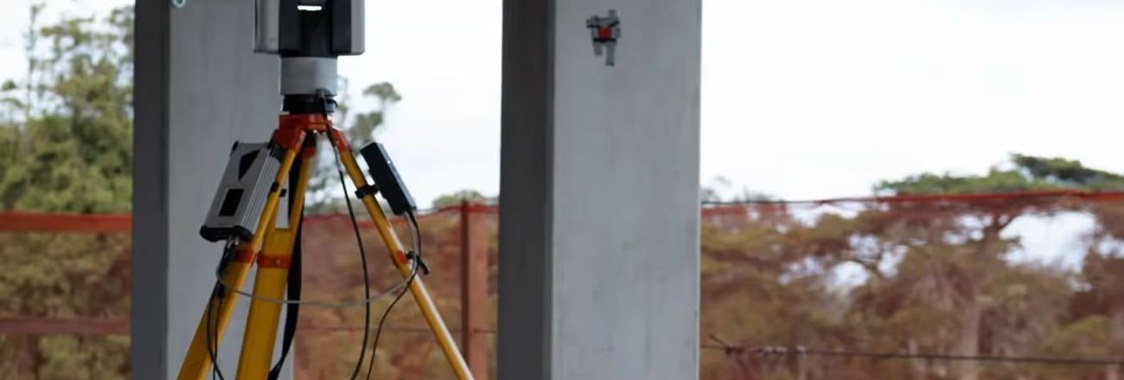
Layout and drilling
Mortenson used Dusty layout across a $1 billion, two-data-center program.
Capture
Turner reports over 95% less inspection time with Spot on mapped routes.
- FieldPrinter beside a total station
- Image: Dusty Robotics
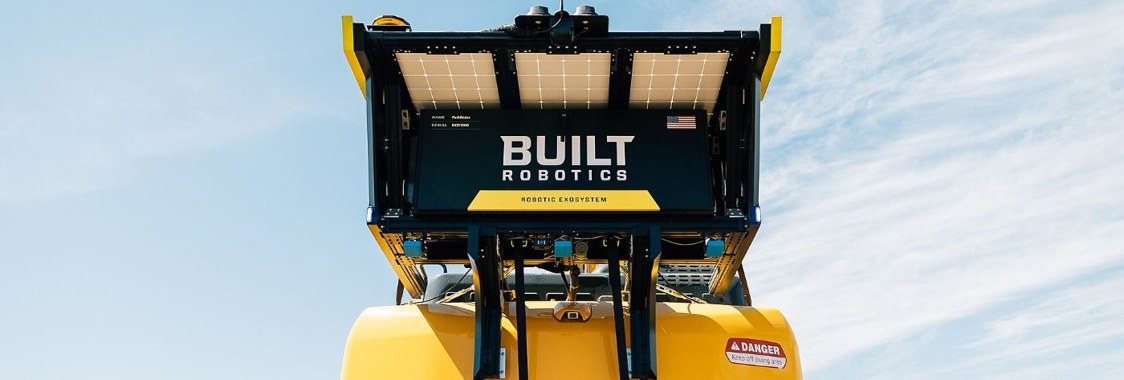
Piling
Built Robotics drives nearly 1,000 piles a day at the Meta Hyperion solar site.
Operations
Inspection patrols run in data center halls and plants.
- Exosystem kit on an excavator
- Photo: Carolinah13 / Built Robotics, Wikimedia Commons, CC BY-SA 4.0
Go deeper: Primer 07 Data Centers covers owners, builders and the full chain.
How EPC and data center builders work with Atomgigs.
Master agreement and teaming fit best.
Master agreement
Terms once, task orders for each site or phase.
Teaming
Pursue large programs with a machine scope and labor plan.
BIM and VDC integration
Connect your coordinated model to layout, drilling and capture.
Pilot
One hall or phase, then replicate across the program.
Replicate what worked on the first site.
A pilot package for EPC and data center builders.
Four to eight weeks on one phase.
Scope
Slab layout and drilling for one hall, or capture and inspection for one building.
What Atomgigs does
Pod lead, machines, crew, safety case, weekly report and a replication plan.
Metrics
Holes or marks per hour, days saved, accuracy, safety, and intervention rate.
Decision
Replicate on the next hall, scale to the program, or stop.
A repeatable pilot becomes a program playbook.
How it works on your project
Win the work, specify and procure, pilot to production, run the site.
6.1 Win the work
Put physical AI into the pursuit and the price.
Win themes
150
Pricing
152
In the proposal
151
Four win themes that machines support.
Owners ask about these on every large pursuit.
Schedule certainty
Machine capacity extends beyond a normal shift and takes repeated tasks off the critical path.
A credible labor plan
Named crews and machines for the peak months, with a fallback if trades are short.
Safety
Fewer people in overhead, height and repetitive work, under a reviewed safety case.
Progress you can see
Daily capture compared with the model, reported weekly to the owner.
Atomgigs writes these sections with your pursuit team, using your template.
What to put in the proposal.
Sections, what to say, and what Atomgigs supplies.
| Section | What to say | Atomgigs supplies |
|---|---|---|
| Approach and schedule | Where machines work and what they take off the critical path | Task plan and capacity by area |
| Labor plan | Crews and machines by phase, and the fallback | Crew plan and pod structure |
| Safety | How people and machines share the site | Safety case outline and training plan |
| Quality and data | How progress and accuracy are measured | Weekly report sample and data plan |
| Price | How the machine scope is priced and shown | Scope estimate in your format |
One or two pages in a proposal is usually enough.
Pricing a machine scope into the bid.
Show it as a clear line, and keep the flex.
As a capacity line
A crew or a robot by the month, for the months you need it.
As a unit line
A price per unit of finished work, such as per hole, mark or tie.
As an allowance
A defined allowance with a trigger and a decision gate, when scope is still forming.
As an alternate
An owner option with a stated schedule benefit, priced separately.
Atomgigs prices from its own estimate, and the structure is agreed with you case by case.
6.2 Specify and procure
Where machine scopes appear in the documents, with sample language.
Where it appears
154
Sample specification language
156
Sample RFP language
155
Submittals
157
Where machine scopes appear in the documents.
Typical locations in a CSI MasterFormat project manual.
| Division | Typical use |
|---|---|
| 01 General Requirements | Project coordination, safety, quality, reporting, submittals and closeout data |
| 03 Concrete | Layout, slab holes, rebar tying and as-built scans |
| 09 Finishes | Wall finishing and spray robots |
| 23 Heating, Ventilating and Air Conditioning | Hanger layout, ceiling drilling and inspection |
| 26 Electrical | Hanger layout, overhead drilling and cable-tray work |
| 31 Earthwork | Autonomous excavation, grading and piling |
Most machine scopes fit into existing sections as methods or alternates.
Sample RFP language for machine scopes.
Language an owner or manager can adapt in a request for proposals.
Evaluation criterion
Proposers shall describe how automation, robotics or drone capture will be used to improve schedule, safety and quality, and shall state the measures to be reported weekly.
Labor plan
Proposers shall provide a labor plan for peak months, including any use of robotic equipment and the named managers responsible for each machine.
Safety
Proposers shall submit a site safety plan addressing shared work areas between workers and robotic equipment, training, and stop-work authority.
Data
The Owner retains ownership of all site data and models. Data shall not be used for training third-party models without written consent.
Atomgigs can adapt these to your own documents and your client's standards.
Sample specification section for robotic layout.
A short example in CSI three-part format.
Part 1 General: summary
This section includes robotic layout of building elements on concrete slabs from the coordinated model, with accuracy and reporting as specified below.
Part 1 General: submittals
Submit equipment data, the risk assessment for the robotic equipment, operator qualifications, and a layout accuracy test plan.
Part 2 Products
Layout equipment shall locate points to the tolerance stated in this section from survey control established by the Contractor.
Part 3 Execution
Verify control points before layout begins. Report layout deviations to the Architect. Provide as-built layout data in the format required for the project record.
Write what the work must achieve. Let qualified machines show they can.
Submittals and approvals for a machine scope.
Typical items the owner and manager will ask for.
Scope and plan
Task plan, working areas, schedule and sequence for each area.
Safety documents
Risk assessment, safety case, zone drawings and emergency procedures.
Equipment data
Maker data sheets, battery and charging plan, and inspection records.
People and data
Operator qualifications and training, insurance certificates, data and network plan.
Atomgigs prepares the submittals so your team reviews rather than writes.
6.3 Pilot to production
How a pilot is run, measured and scaled.
Six steps
Metrics
159
160
Decision gate
To production
161
162
A pilot runs in six steps over four to eight weeks.
One defined scope, agreed measures, a decision at the end.
Scope and baseline
Choose one repeated task and area, and measure the manual baseline before machines start.
Mobilize
Site readiness check, model and control points, safety case, training, machines and crew on site.
Run and measure
Operate in the chosen area with weekly reports on output, accuracy, safety and interventions.
Decide
Compare results with the baseline and agree the next step at a decision gate.
The decision is written into the agreement before the pilot begins.
Seven measures judge a pilot.
Agree these before mobilizing.
| Measure | How it is measured |
|---|---|
| Output per hour | Units finished per hour against the manual baseline |
| Accuracy | Deviation from the model, from scans |
| Schedule effect | Days saved on the task or the area |
| Safety | Observations, near misses, stops and incidents |
| Uptime | Machine availability during planned hours |
| Intervention rate | How often a person had to step in |
| Cost per unit | Total cost of the scope divided by units finished |
Measure at 60% of the maker's claims first. If it holds there, the case is sound.
At the gate: scale, adjust or stop.
Each outcome is a good outcome if the evidence is clear.
- Metrics meet the agreed bar.
- Extend to more areas or floors.
- Move to a managed crew or master agreement.
Scale
- Some measures fall short.
- Change the task, the machine or the area.
- Run a short second phase.
Adjust
- The case does not hold on this scope.
- Demobilize cleanly with data handed over.
- Keep the learning for the next project.
Stop
You never commit beyond what the evidence supports.
From pilot to production.
Scale in stages, and shift the pricing as results are proven.
Expand the area
More floors, halls or zones with the same machines and playbook.
Add tasks
Layout, drilling and capture first, then hauling, finishing and inspection.
Add sites
A master agreement, so the next project starts quickly.
Shift to outcomes
Move from capacity pricing to price per unit as measures stabilize.
Each stage has its own gate.
6.4 Run the site
How the pod, your crews and the safety rules work together.
Who does what
Safety on a live site
164
165
Working with labor
Closeout
166
167
The pod and your crews: who does what.
A typical split on a live site.
| Role | Responsibility |
|---|---|
| Your project manager | Owner relationship, master schedule, access and approvals |
| Atomgigs pod lead | Machine scope, schedule and outcome; weekly report; interface to you |
| Robotics lead | Machines, tooling, fleet uptime and maker coordination |
| Your foremen and crews | Skilled work beside the machines, and finishing |
| Atomgigs skilled crew | Trades supplied under the pod, with a foreman each shift |
| Safety and compliance | Joint site plan, robot zones, training and stop-work authority |
A morning huddle and a weekly review keep the two teams together.
Safety on a live site.
People and machines share the work area under written rules.
Zones
Marked work zones, speed limits and keep-out areas for each machine.
Training
Every worker who shares the area is trained before mobilization and at each change.
Stops and authority
Emergency stops, stop-work authority and clear restart rules.
Batteries and charging
Charging areas reviewed with the owner and insurer.
Reporting
Observations and near misses logged and reviewed weekly.
Review cycle
The safety case is re-validated after any change of area, task or machine.
We never move faster than safety permits.
Bring crews and unions along from the start.
Unions and workers are shaping how autonomy arrives.
Early conversation
Explain what machines take on, and what they do not, before mobilizing.
Skilled work stays
Machines take repetitive and hazardous tasks. People keep judgment work and supervision.
Training and roles
Crew members can cross-train on the fleet and take new technician roles.
Clear agreements
Respect jurisdiction and work rules, and write the machine scope into labor agreements where required.
Machines succeed when the crew wants them on site.
Closeout and handover.
What you and your client receive at the end.
As-built scans
Final scans compared with the model, with deviations listed.
Data and reports
Weekly reports, metrics and records, handed over in agreed formats.
Digital twin
An as-built model for the owner's operations team.
Demobilize or stay
Machines leave cleanly, or Atomgigs stays to operate patrols and monitoring.
Staying to operate gives your client one team from build to operations.
Atomgigs in your market
Outlook, how to start, remember and go deeper.
7.1 Outlook
Where physical AI is heading, and what could change the pace.
Where the market is heading
170
International notes
172
Faster or slower
171
Robot adoption is growing from several directions.
Counts of robots in use and sold, from the International Federation of Robotics and others.
Contractors
BuiltWorlds finds 79% of surveyed contractors using jobsite robotics in 2026, against 29% a year earlier.
Hyperscalers
2026 capital spending of more than $720 billion keeps pulling data center and power work.
Industrial arms are scaled. Service robots are growing fast. Humanoids are early.
What could speed adoption, and what could stall it.
Factors to watch over the next two years.
- Persistent labor gaps and retirements.
- Data center and power build-out.
- Clear standards and insurance products.
- More named deployments with measured results.
Could speed it up
- Safety incidents and slow standards.
- Maker cash stress and failures.
- Trade rules and tariffs changing the cost.
- Contracts and unions slow to adapt.
Could slow it down
Atomgigs sources from many makers, so a single maker's problem does not stop your project.
International notes: the market is global.
The deck is U.S.-first. Partners with international work should note these.
China leads installations
China installed 59% of the world's industrial robots in 2025.
Europe
EU machinery and AI rules arrive in 2027 and affect robots sold or used there.
Contracts
FIDIC forms are common on international projects, and Atomgigs works within them.
Delivery
Atomgigs starts in the U.S. and works with partners on international scopes case by case.
If you work across borders, tell us early so we can plan machines, labor and rules.
7.2 How to start
The engagement path, the first thirty days, and one conversation.
The path
174
One conversation
176
First thirty days
175
The engagement path: consulting, pilot, production.
Three stages, with a decision gate at each step.
- 1 Consulting engagement
- Two to four weeks. Review your projects, find the best first task, design the pilot and agree measures and structure.
- 2 Pilot
- Four to eight weeks on one live scope with a mixed crew and one or two robot tasks. Weekly reports and a decision at the end.
- 3 Production
- A managed crew or outcome-based work across areas and sites, under a task order or master agreement.
Your control
At every gate you can scale, adjust or stop. No machine purchase and no long-term headcount.
You can start with a conversation, and the first step is advisory.
Your first thirty days.
A typical start for a partner.
- 1Week 1
Week 1: Discover Meet your leaders, review the project list and pick one or two candidate tasks.
- 2Week 2
Week 1: Discover Meet your leaders, review the project list and pick one or two candidate tasks.
- 3Week 3
Week 2: Assess Review models, site and contract. Check readiness and safety needs.
- 4Week 4
Week 2: Assess Review models, site and contract. Check readiness and safety needs.
Week 3: Design
Draft the pilot scope, measures, structure and the model of working together.
Week 4: Decide
Agree the engagement, and start mobilizing or proposing to your client.
By day thirty you can have a signed pilot or a proposal in front of your client.
Start with one conversation.
What to bring, and what Atomgigs brings.
- Your current and upcoming projects.
- A task that is repeated, dull or unsafe.
- Access to a model and a site contact.
You bring
- Machines from many makers.
- Skilled labor and a senior pod.
- Safety cases, data and reporting.
Atomgigs brings
- atomgigs.com
- [email protected]
- +1-310-694-4750
Contact
Scale up your build with Physical AI
7.3 Remember and go deeper
Ten things to remember, and the other primers.
Ten things
178
Go deeper
179
Ten things to remember.
The essentials from this primer.
The pressure is structural
The industry needs 349,000 net new workers in 2026, and productivity has not kept pace.
Backlog is high
Most large contractors report higher backlog. Crews are the constraint.
Proof is task by task
Layout, drilling, capture, piling, rebar and inspection lead.
Humanoids are early
Treat them as pilots, not production.
Maker claims need testing
A short pilot turns a claim into your own result.
Budget the whole cost
At least three times the machine price.
Safety is not optional
OSHA has no robot rule. General duties and consensus standards apply.
Seven ways to work together
Teaming, subcontract, referral, white-label, master agreement, BIM and VDC integration, advisory.
Engineers lead
Specifications written for machines make machine scopes real.
Start small
Consulting, pilot, production, with a gate at each step.
Go deeper in the other Atomgigs primers.
Each covers one part of the world in more detail.
| Primer | Address | Read it for |
|---|---|---|
| 00 Value Proposition | atomgigs.com | Why Atomgigs, and how it works |
| 01 Robotics | atomgigs.com/robots | Robot classes, makers, prices, safety, workforce and 22 profiles |
| 02 OEMs, Drones and VTOL | atomgigs.com/oems | Robot, drone and equipment makers and their go-to-market |
| 03 Talent | atomgigs.com/talent | The skilled labor Atomgigs brings and how it is sourced |
| 04 Investors | atomgigs.com/investors | Where physical AI capital is going, and how to find and track deals |
| 05 Enablers | atomgigs.com/enablers | The organizations that pay for, insure, run and approve machines at work |
| 07 Data Centers | atomgigs.com/data-center | Owners, builders, power and cooling, and where robots fit |
| 08 Manufacturing and Logistics | atomgigs.com/manufacturing | Plants, warehouses and logistics operations |
| 09 Construction and Infrastructure | atomgigs.com/construction | The project lifecycle, delivery methods, trades and safety |
| 10 Public Safety and Defense | atomgigs.com/public-safety | Extending public safety and defense teams with machines. No weapons |
| 11 Commercial Services | atomgigs.com/commercial | Where robots, drones and automation work in service businesses |
| 12 Physical AI Labs | atomgigs.com/labs | Physical AI data for training robots, only with customer approval |
| 13 Physical AI Technology | atomgigs.com/technology | The stack behind robots: compute, sensing, control, AI models, simulation |
About us and notes
The primers, Atomgigs, Mavengigs, Monty Pandey, notes.
The primers, one address each
Every primer is readable on atomgigs.com or in presentation mode.
| # | Primer | Address | What it promises |
|---|---|---|---|
| 00 | Value Proposition | atomgigs.com | Why Atomgigs, and how it works. |
| 01 | Robotics | atomgigs.com/robots | Every robot type, for every application. |
| 02 | OEMs, Drones and VTOL | atomgigs.com/oems | Everything that helps people work in the physical world, other than robots. |
| 03 | Talent | atomgigs.com/talent | The experts who work alongside physical AI. |
| 04 | Investors | atomgigs.com/investors | Where physical AI capital is going, and how to find and track deals. |
| 05 | Enablers | atomgigs.com/enablers | The organizations that pay for, insure, run and approve machines at work. |
| 06 | Channel Partners | atomgigs.com/channel-partners | Winning and delivering projects with physical AI. |
| 07 | Data Centers | atomgigs.com/data-center | How data centers are built, run and paid for, and who buys them. |
| 08 | Manufacturing and Logistics | atomgigs.com/manufacturing | How goods are made, stored and moved. |
| 09 | Construction and Infrastructure | atomgigs.com/construction | How we build and run the physical world. |
| 10 | Public Safety and Defense | atomgigs.com/public-safety | Extending public safety and defense teams with machines. No weapons. |
| 11 | Commercial Services | atomgigs.com/commercial | Where robots, drones and automation work in service businesses. |
| 12 | Physical AI Labs | atomgigs.com/labs | Physical AI data for training robots, only with customer approval. |
| 13 | Physical AI Technology | atomgigs.com/technology | The stack behind robots, from silicon to fleet. |
Atomgigs: Physical AI Delivered as Jobs Done
Machines and people as one hybrid workforce, to scale up what you build and run. Primers hold the details.
What Atomgigs is
- Robots, drones, VTOL, IoT and automation, with people, as one hybrid workforce.
- Humans in the lead, physical AI in the loop.
- Not a machine builder: it sources from makers, then staffs, integrates, deploys and operates.
The sources
- Robots: every robot type, profiled in depth.
- Everything other than robots: drones, VTOL, IoT and automation, from many makers.
- The humans: role families across the trades, engineering and safety, every person a contractor.
Who we work with
- Investors: consulting before and after the deal.
- Enablers: financiers, insurers, platforms and regulators behind every deal.
- Channel partners: engineering, design, MEP and construction firms.
Buyer groups
- Data centers
- Manufacturing and logistics
- Construction and infrastructure
- Public safety and defense (no weapons)
- Commercial services
- Physical AI labs
How it works
- Consulting engagement, then a short pilot, then production.
- One scope, one site, one metric in the pilot.
- A small senior pod runs every site, with a named human manager for every robot.
How we are paid
- Pilot, managed crew, outcome-based or advisory.
- No capital outlay for machines and no long-term headcount.
- Pay for capacity and outcomes; scale up as results are proven.
Atomgigs is a Mavengigs venture. Atomgigs is a division of Panvisage Inc.
Mavengigs: the Scale Up Guys
Consulting, Capital and Ventures.
Mavengigs Consulting
- Strategic M&A, transformation and optimization
- Focused on the part of M&A that begins after everyone shakes hands
- Built for PE-backed and Fortune 500 teams
Mavengigs Capital
- An independent sponsor platform
- Family office strategy and management
Mavengigs Ventures
- Funding and mentorship for founders we back
- Panmedical: digital health in India, run as CEO
- Atomgigs, Mavens Life and Mavens Health
Mavengigs is a division of Panvisage Inc.
Monty Pandey: Founder and CEO
Founder, CEO and driving force behind Atomgigs

Career and experience
- 30+ years of management consulting: managed major M&A deals totaling $20 billion; scaled 50+ companies for $100 million of impact
- Deep expertise in M&A consulting, including integrations and divestitures
- 2018 to present: Mavengigs: Consulting, Capital and Ventures
- 2004 to present: Founded Panvisage, CEO for 22 years
- 2024 to present: Panmedical CEO (digital health)
- 1998 to 2004: Oracle, led 14 enterprise programs
- 1994 to 1996: Rolled out nationwide cell networks
- 1992 to 1994: Car and truck design (CAD, CAM, CIM)
- 1991: B.E. Electrical and Electronics Engineering
- 1989 to 1991: Designed robots, AGVs and manufacturing transfer lines
- Data centers: built one from scratch in 2000; data center migration in 2008; Equinix in 2020
- E&C companies: WSP, Jacobs, Worley, Halliburton, Fluor, Brown & Root
- Managed the buildout of a manufacturing plant and a distribution center
Monty Pandey
- Founder and CEO, Atomgigs
- Founder and CEO, Mavengigs
- Co-founder and CEO, Panmedical
| Selected transactions | Value | Role |
|---|---|---|
| GE Appliances / Haier | $5.6B | Readied for sale |
| Jacobs / CH2M / Worley | $3.3B | Integration, Divestiture |
| ITW Signode / Carlyle | $3.2B | Carve-out, then sale |
| AMLI / Morgan Stanley | $2.1B | Take-private |
| Fortune Brands / ACCO / GBC | $2B | Divestiture, Integration |
| Equinix / Packet | $335M | Integration |
Notes on use
Three things to keep in mind when reading this deck.
Not investment advice
Atomgigs provides consulting. We are not an investment advisor, so you make your own decisions on investments.
Products belong to their owners
Company, product and robot names, logos and photos are used as examples and belong to their owners. This deck is for information only and is not a contract or an offer.
About the numbers
Numbers come from publicly available sources and are the latest available at publication. Costs, prices and returns are typical ballpark values, not quotes; they will be updated for your specific engagement.
Reference
Glossary, key numbers and rules of thumb, organizations.
Glossary, part one.
Terms used in this primer, A to H.
| Term | Meaning |
|---|---|
| AGV | Automated guided vehicle that follows a fixed path, such as a forklift AGV. |
| AMR | Autonomous mobile robot that plans its own route around people and obstacles. |
| BIM | Building information modeling: a data-rich 3D model of a building or structure. |
| CMAR | Construction manager at risk: the CM joins early and guarantees a maximum price. |
| Cobot | A collaborative robot arm designed to work near people. |
| CSI MasterFormat | The standard numbering of specification divisions used on U.S. projects. |
| Design-build | One contract for both design and construction. |
| Digital twin | A living digital copy of a site and everything installed on it. |
| EPC and EPCM | Engineer, procure and construct; or engineer, procure and manage construction. |
| GMP | Guaranteed maximum price: actual cost plus fee, capped. |
| Hybrid crew | A crew of people and robots, with robots on dull and dangerous tasks. |
Glossary, part two.
Terms used in this primer, H to V.
| Term | Meaning |
|---|---|
| Humanoid | A robot with a human-like body that can walk and handle objects. |
| IPD | Integrated project delivery: owner, designer and builder share one agreement and risk. |
| MEP | Mechanical, electrical and plumbing systems, and the trades that install them. |
| Physical AI | Robots, drones, automation, IoT devices and digital twins that do or support work in the physical world. |
| Pilot | A scoped, time-boxed trial on a live project, usually four to eight weeks. |
| Point cloud | A set of measured 3D points captured by a scanner or drone. |
| RaaS | Robot as a service: the maker owns the robot and charges a fixed monthly fee. |
| SAAR | Seasonally adjusted annual rate: a monthly figure expressed as a yearly total. |
| Site pod | The small senior team Atomgigs puts on a project. |
| TCO | Total cost of ownership: all costs to acquire, integrate, operate and maintain. |
| VDC | Virtual design and construction: using models to plan and coordinate a build. |
Quick reference: key numbers and rules of thumb.
The figures to carry into a conversation.
| Number | What it is |
|---|---|
| $2.19 trillion | U.S. construction spending a year, September 2026 (Census) |
| 349,000 | Net new construction workers needed in 2026 (ABC) |
| 11.8% | Growth in Top 400 contractor revenue in 2025 (ENR) |
| 86.4% | Growth in telecom and data center work among Top 400 firms (ENR) |
| Over $720 billion | 2026 capex outlook, Amazon, Alphabet, Microsoft and Meta |
| 79% | Surveyed contractors using jobsite robotics in 2026 (BuiltWorlds) |
| 20% and 80% | Typical schedule overrun and maximum budget overrun on large projects (McKinsey) |
| 44% to 47% | Design-build share of U.S. spending, today to 2028 (FMI and DBIA) |
| 3x | Budget at least three times the machine price (BCG-cited rule) |
| 4 to 8 weeks | A typical Atomgigs pilot |
| 60% | Test whether payback holds at 60% of the maker's claims |
Organizations that shape the industry, part one.
Trade bodies and contract-document publishers.
| Organization | Role |
|---|---|
| ABC | Associated Builders and Contractors: merit-shop trade association; publishes workforce estimates |
| AGC | Associated General Contractors of America: national contractors association |
| NCCER | National Center for Construction Education and Research: craft training and credentials |
| DBIA | Design-Build Institute of America: design-build education and contract documents |
| AIA | American Institute of Architects: publishes AIA Contract Documents |
| ConsensusDocs | Contract documents from a coalition of owner, contractor, design and surety associations |
| EJCDC | Engineers Joint Contract Documents Committee: engineer-led public works documents |
| FIDIC | International Federation of Consulting Engineers: Red, Yellow and Silver Books |
Organizations that shape the industry, part two.
Standards, safety, data and rankings.
| Organization | Role |
|---|---|
| CSI | Construction Specifications Institute: MasterFormat specification divisions |
| OSHA | Occupational Safety and Health Administration: no robot-specific standard; general duties apply |
| NIOSH | National Institute for Occupational Safety and Health: robotics research center founded 2017 |
| A3 | Association for Advancing Automation: includes the Robotic Industries Association and its R15 standards |
| ISO | International Organization for Standardization: ISO 12100, ISO 10218 and the draft ISO 25785-1 |
| IFR | International Federation of Robotics: World Robotics statistics |
| ENR | Engineering News-Record: Top 400 Contractors, Top 500 Design Firms and Top 600 Specialty lists |
| U.S. Census Bureau | Monthly construction spending data |
Have a project that needs hands and machines?
Tell us about the site, the scope and the schedule. We will come back with a pilot proposal.